

Chinese
Chinese
What actually determines whether your system holds up long-term comes down to four things: whether the cells are inherently safe, whether the system architecture is built to stay reliable, whether the cycle life actually covers your project timeline, and whether any of this has been proven in the field, not just in a lab.
Winston Battery is one of the few LiFePO4 manufacturers where these four things hold up at the same time, backed by 25 years of deployments across 70+ countries. Here's what that looks like in practice.
The most important safety question you can ask any LiFePO4 supplier is this: if the battery management system (BMS) stops working, what does the cell do on its own?
The BMS is the electronic system that monitors and protects your battery. Most LiFePO4 cells depend on it entirely. If it fails or disconnects, the cell's own behavior under stress is the only thing standing between normal operation and thermal runaway, where a cell overheats uncontrollably and can cause fire or toxic gas release.
Winston Battery's proprietary LYP (Yttrium-enhanced Lithium Iron Phosphate, a water-based safety chemistry) is designed to handle exactly that scenario. The cell chemistry is designed to maintain a significantly higher passive safety margin even if active protection is unavailable. This isn't a feature that activates. It's a property of the chemistry.
LYP chemistry is designed to avoid the HF-related thermal stress profile associated with many other lithium systems. If a thermal event does occur, the cells can be suppressed with ordinary water.
If your system sits in an engine room, a sealed container, or an unmanned facility, that's a meaningful difference. Your emergency response protocol becomes simpler, and your last line of defense doesn't depend on electronics working correctly.
The most failure-prone part of a battery system usually isn't the cell itself. It's the connection points. Every joint, every weld, every terminal is a potential site for loosening, corrosion, or rising contact resistance over time.
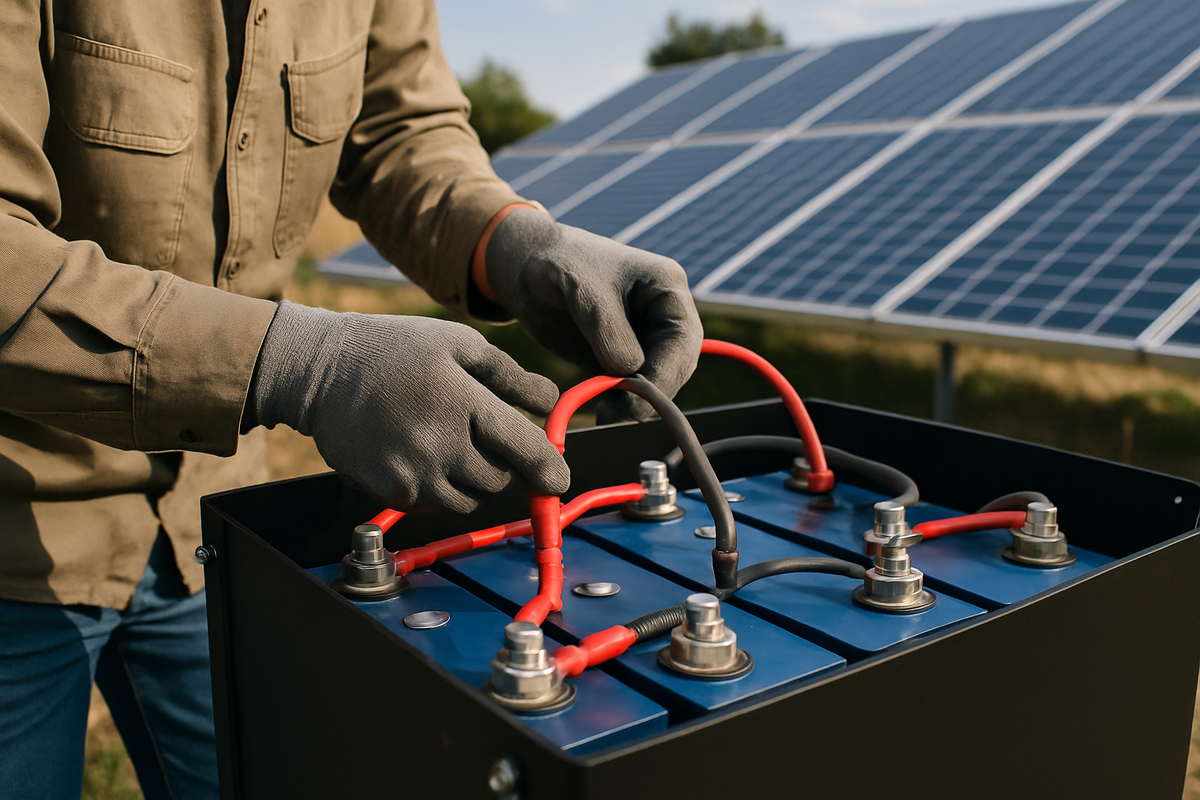
The simplest way to reduce that risk is to use fewer cells for the same total capacity. Most LiFePO4 cells on the market today fall in the 5 to 20Ah range. Winston Battery's prismatic cells are available from 50Ah to 1,000Ah, roughly 5 to 20 times larger. That's been a consistent design choice since the beginning, not a recent upsizing.
Fewer cells means fewer connection points, fewer welds, and lower contact resistance risk across the entire system. For your project, that translates directly into less scheduled maintenance, fewer unplanned service calls, and a system that's less likely to develop issues as it ages.
Winston Battery's cells use a polymer casing with a controlled venting mechanism that releases pressure gradually under abnormal conditions. The polymer also provides natural electrical insulation between cells and inherent corrosion resistance in high-salinity environments. If your system is going on a vessel, near the coast, or offshore, that's one less layer of protection you need to engineer into the design yourself.
A cycle life number on a spec sheet only means something if you know the testing conditions behind it. The key question is: at what depth of discharge (DOD), meaning how much of the battery's capacity is used each cycle?
A rating tested at 50% DOD tells a very different story from one tested at 70% or 80%. Without that context, the headline number is hard to act on.
Winston Battery's LYP cells are rated for 8,000 cycles at 70% DOD. In most applications with one to two cycles per day, that translates to 10 to 20 years of real-world service. For many projects, that means the battery system covers the full lifecycle without needing replacement, so you won't face the cost and disruption of swapping out the system mid-project.
That cycle life number directly reshapes your total cost of ownership (TCO), the full cost across the system's entire service life. Here's what a complete TCO calculation should include:
| TCO Dimension | What to Include |
|---|---|
| Initial cost | Battery system + installation + commissioning |
| Replacement cost | If replacement is needed within the project lifecycle: equipment + labor + downtime losses |
| Maintenance cost | Periodic inspection, connection point servicing, BMS calibration |
| Disposal cost | End-of-life recycling and handling |
| Insurance cost | Premium differences based on battery system safety profile |
When cycle life covers 10 to 20 years, two of the largest hidden cost items, replacement and downtime, can drop to zero. That's often where the real difference between brands shows up, not in the purchase price, but in what you don't have to spend afterward.
If you want to see how this applies to your specific operating conditions, Winston Battery's technical team can walk you through a TCO projection based on your actual usage profile.
If your project is in a hot engine room, a sub-zero climate, or a high-salinity coastal environment, the first thing to figure out is whether the battery can handle it without adding a separate heating or cooling system.
Most LiFePO4 cells operate within -20°C to +50°C. Outside that range, you typically need thermal management, which adds components, cost, complexity, and more potential failure points.
Winston Battery's LYP cell chemistry supports -45°C to +85°C. In many extreme-environment applications, that eliminates the need for a dedicated thermal management system altogether. That's one less subsystem to spec, install, maintain, and troubleshoot over the life of your project.
Discharge capability is just as important. Most LiFePO4 cells are rated for 1C continuous discharge. Winston Battery's LYP cells deliver 3C continuous and 10C peak.
If your system drives thrusters, winches, or large pump sets, the cell platform provides substantial current headroom. Actual output is governed by the BMS and system configuration, but when discharge limits are set appropriately, the battery can deliver high current without undue damage to the cells.
Wide temperature tolerance, high discharge capability, and corrosion resistance working together means your system design can be simpler, lighter, and carry fewer points of failure. If you're not sure whether your project environment falls within these parameters, Winston Battery's engineering team can help you evaluate before you commit to a configuration.
Any brand can write "high reliability" on a product page. The real question is: how many years of actual deployment data sit behind that claim?
Winston Battery has been manufacturing and deploying LiFePO4 systems continuously for over 25 years, across more than 70 countries. That includes offshore platforms, industrial energy storage installations, extreme-climate infrastructure, and commercial marine vessels in both tropical and sub-arctic waters.
For your project, that means most of the conditions you're likely to encounter have already been tested in the field, over years of continuous operation, not just simulated in a lab. And if your application involves unusual environmental or load requirements, there's a good chance Winston Battery has seen something similar before and can advise based on real operational history.
Winston Battery's systems carry AXA global insurance coverage — a financial commitment based on actuarial evaluation, not a marketing endorsement. In practice, it can help lower your project's battery-related insurance premiums, simplify conversations with underwriters, and give your clients or investors an additional layer of confidence.
A battery system is a 10-to-20-year asset. The brand you choose today needs to still be there when you need replacement cells or technical support a decade from now.
Winston Battery's involvement starts at the project design stage, before you've placed an order, and extends through commissioning, operation, and long-term maintenance. That includes sizing and configuration consultation for your specific application, technical support for system integration, on-site commissioning assistance, and long-term access to spare parts and replacement cells.
If your project requirements change mid-lifecycle, or if you need to scale a system up after initial deployment, that ongoing relationship means you're not starting from scratch with a new supplier. You're working with a team that already knows your setup.
Winston Battery has been in continuous operation for over 25 years. That's not a startup promising future support. It's a demonstrated track record of supply chain stability, manufacturing continuity, and ongoing service across decades.
Quality, value, and long-term reliability don't have to be a trade-off. When the cell chemistry is inherently safe, the cell format simplifies the architecture, the cycle life covers your full project timeline, and the operating range matches your real-world conditions, these dimensions reinforce each other instead of competing.
That's what Winston Battery's system-level approach is built to deliver. And with 25 years of field data across 70+ countries, it's already been tested in conditions similar to yours.
If you're working on a project where long-term battery performance matters, here's the most useful next step: Send Winston Battery your project details — including your operating environment, expected usage profile, and any specific requirements. The engineering team can help you evaluate whether this system fits your application, and walk you through a configuration and TCO projection tailored to your situation.
You can also explore the full range of Winston Battery system-level solutions to see what's available for your application.