

Chinese
Chinese
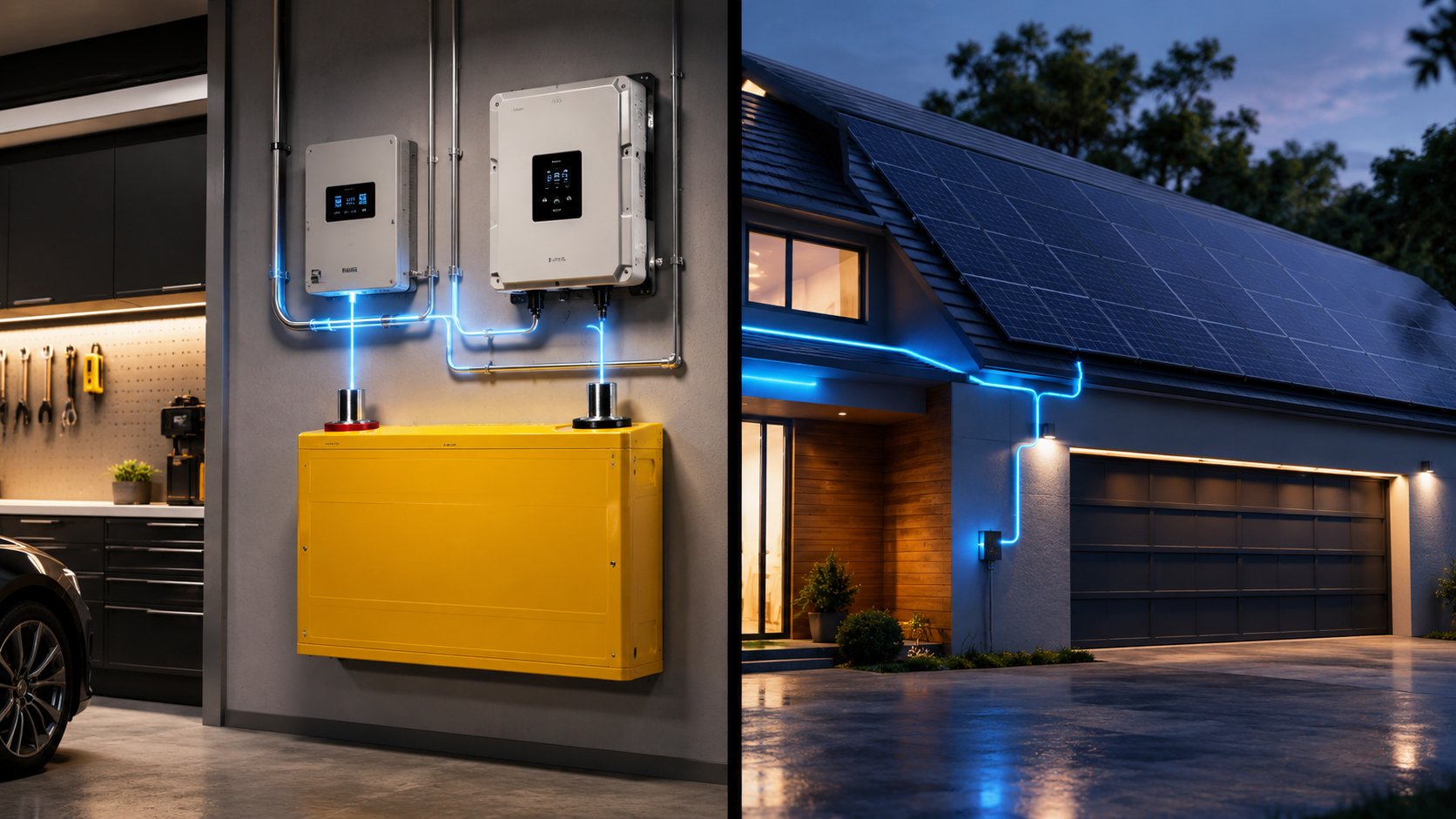
The best type of battery for energy storage is the one sized correctly to your load. Wrong battery size kills projects. Undersized, your system can't meet peak demand and fails during outages. Oversized, you waste capital on cells that sit idle. Sizing is a three-part calculation: daily energy requirement, discharge rate matching, and series/parallel architecture. This guide walks through the math with real examples so you can specify exactly what you need.
Energy requirement is the total kilowatt-hours (kWh) your load consumes in 24 hours.
Step 1: Audit your load profile.
List all loads and their daily usage:
| Load | Power (W) | Hours/Day | Daily Energy (Wh) |
|---|---|---|---|
| Refrigerator | 150 | 24 | 3,600 |
| Lighting (8 bulbs) | 80 | 6 | 480 |
| Water pump | 500 | 2 | 1,000 |
| Inverter/system losses | — | — | 500 |
| TOTAL DAILY | — | — | 5,580 Wh |
This system needs 5.58 kWh per day.
Step 2: Classify loads as critical vs. non-critical.
Critical loads must run during outages. Non-critical loads shed if the battery is depleted. In the example above:
Critical: Refrigerator (perishables), water pump (health/sanitation)
Non-critical: Lighting (can reduce hours)
Size your battery to cover critical loads for your desired autonomy period (usually 2–5 days).
Step 3: Account for generation source (solar, wind, grid).
If your system has solar:
On sunny days, solar recharges the battery during daylight.
Battery only covers nighttime and cloudy-day shortfall.
In the example, if solar produces 6 kWh/day on average and loads consume 5.58 kWh, the battery only needs to bridge the 2–3 hours of peak evening demand (maybe 1 kWh). Autonomy days = 1, not 5.
If your system is grid-backed:
Battery bridges power outages (typically 4–8 hours).
Calculate energy needed for that window only.
If your system is off-grid:
Battery covers the worst-case season (winter, rainy season).
Autonomy = 3–7 days depending on climate.
Not all rated capacity is usable. Depth-of-discharge (DOD) determines how much you extract before recharging.
Depth-of-Discharge (DOD) targets:
| DOD | Cycle Life Impact | Use Case |
|---|---|---|
| 50% | Minimal degradation; longest life | Stationary backup; low cycling |
| 70% | Moderate; industry standard | Daily cycling; good balance |
| 100% | Rapid degradation; short life | Mobile/temporary apps only |
Sizing formula:
``` Required usable capacity (kWh) = Daily energy (kWh) × Autonomy days / DOD target
Required usable capacity = Daily energy (kWh) × Autonomy days / DOD target ```
Example 1: Off-grid home, 5 autonomy days, 70% DOD ``` Required = 5.58 kWh × 5 days / 0.70 = 39.86 kWh usable ```
To achieve 39.86 kWh usable at 70% DOD: ``` Rated capacity = 39.86 / 0.70 = 56.9 kWh rated ```
Example 2: Grid-backed home, 4-hour outage window, 80% DOD ``` Hourly requirement = 5.58 kWh / 24 hours = 0.233 kW average Peak evening load = 1.5 kW (refrigerator + lighting) 4-hour reserve = 1.5 kW × 4 hours = 6 kWh usable Required rated = 6 kWh / 0.80 = 7.5 kWh rated ```
Rule of thumb: Add 20–30% headroom to the calculated capacity for growth and seasonal variation. A system calculated at 39.86 kWh should be specified at 48–52 kWh rated.
Discharge rate is how fast the battery supplies current, expressed as a C-rate (multiples of capacity per hour).
C-rate definition:
1C = entire capacity in 1 hour
2C = entire capacity in 30 minutes
0.5C = entire capacity in 2 hours
10C = entire capacity in 6 minutes (momentary surge)
Your battery must supply enough current for peak load without thermal stress.
Calculate required discharge rate:
``` Required discharge rate (A) = Peak load (W) / System voltage (V) Required C-rate = Required discharge rate / Cell capacity (Ah) ```
Example 3: 48V system, 100Ah cells, 5kW peak load ``` Required discharge = 5,000 W / 48 V = 104.2 A Single cell capacity = 100 Ah C-rate = 104.2 A / 100 Ah = 1.04C (sustained) ```
This system can discharge at 1C sustained, which is reasonable for LiFePO4 (rated 3C sustained, 10C momentary).
Typical discharge rate specs:
| Chemistry | Sustained | Momentary (peak, <10s) |
|---|---|---|
| LiFePO4 | 1C–3C | 10C |
| NMC | 0.5C–2C | 5C |
| Lead-Acid | 0.5C–1C | 3C |
If your calculated C-rate exceeds the chemistry's sustained rating, either increase cell capacity or use parallel strings to share the load.
Example 4: 48V system, same 5kW peak, using 2 parallel strings of 50Ah cells ``` Total capacity: 100 Ah (2 strings × 50 Ah) C-rate = 104.2 A / 100 Ah = 1.04C ``` Same math, but now each string carries 52.1 A (1.04C / 2 strings = 0.52C per string). Much safer margin.
Series increases voltage; parallel increases capacity and current-handling.
Series configuration determines voltage:
| Target Voltage | Series Count (S) | Config Example (4.8V cells) |
|---|---|---|
| 12.8V | 4S | 4 cells in series |
| 25.6V | 8S | 8 cells in series |
| 51.2V (48V nominal) | 16S | 16 cells in series |
Voltage formula: ``` System voltage = Series count × Nominal cell voltage 48V system = 16S × 3.2V per cell (LiFePO4) ```
Parallel configuration determines capacity and current-sharing:
``` Total capacity = Parallel count (P) × Cell capacity (Ah) ```
Example 5: 48V, 300Ah system using 100Ah cells ``` Voltage = 16S × 3.2V = 51.2V ✓ Capacity = 3P × 100 Ah = 300 Ah ✓ (3 parallel strings, each with 16 cells in series) ```
Wiring diagram (simplified): ``` String 1: Cell1-S1 → Cell2-S1 → ... → Cell16-S1 String 2: Cell1-S2 → Cell2-S2 → ... → Cell16-S2 String 3: Cell1-S3 → Cell2-S3 → ... → Cell16-S3
All 3 strings connected in parallel = 300Ah @ 51.2V ```
Advantage of parallel strings:
Current is shared. Each string carries 1/3 of the discharge current.
If one string fails, the system degraded but survives.
Easier to balance cell voltages in a BMS.
Real systems lose 5–10% to inverter conversion, wiring resistance, and BMS overhead.
Inverter efficiency:
Modern inverters: 92–97% efficient
Older models: 85–90%
Wiring loss (DC side):
Properly sized cables: 1–2% loss
Undersized cables: 5–10% loss (avoid this)
BMS overhead:
Modern BMS: 0.5–1.5% loss
Passive monitoring: <0.5%
Total system efficiency: ``` System efficiency = Inverter efficiency × (1 − Wiring loss) × (1 − BMS loss) Example: 0.95 × 0.98 × 0.99 = 0.92 (92% round-trip) ```
Revised sizing formula with losses:
``` Battery capacity required = Daily load / (System voltage × DOD target × System efficiency) ```
Example 6: Recalculate with losses ``` Daily load: 10 kWh System voltage: 48V (51.2V nominal) DOD target: 70% System efficiency: 92%
Required capacity = 10 kWh / (0.512 × 0.70 × 0.92) = 10 / 0.330 = 30.3 kWh usable
Rated capacity = 30.3 / 0.70 = 43.3 kWh rated ```
Compare to Example 1 (without loss adjustment): 39.86 kWh. The 3.4 kWh difference is the loss buffer. Always account for it.
Before specifying a battery, verify:
[ ] Daily load audit complete (kWh/day)
[ ] Autonomy period defined (how many days without recharge?)
[ ] DOD target chosen (50%, 70%, or 80%)
[ ] Peak load identified (watts)
[ ] Discharge C-rate calculated and compared to chemistry spec
[ ] Series count chosen (voltage target: 12.8V, 25.6V, 48V, etc.)
[ ] Parallel count chosen (capacity target in Ah)
[ ] System efficiency estimated (inverter + wiring + BMS)
[ ] 20–30% growth headroom added
[ ] BMS and inverter specs match battery voltage and current rating
[ ] Final capacity spec includes usable + reserve margin
Scenario: Grid-backed 48V home solar system, 15kWh daily load, 4-hour outage window, LiFePO4
| Step | Calculation | Result |
|---|---|---|
| 1. Daily load audit | (From meter data or device-by-device survey) | 15 kWh |
| 2. Outage window | Grid outages rare; 4 hours max | 4 hours |
| 3. Peak load during outage | Refrigerator + water heater + lighting | 3.5 kW |
| 4. Energy for 4-hour window | 3.5 kW × 4 h = 14 kWh | 14 kWh needed |
| 5. DOD target (grid-backed, rare cycling) | 80% is acceptable | 80% DOD |
| 6. Usable capacity required | 14 kWh / 0.80 = 17.5 kWh usable | 17.5 kWh |
| 7. Rated capacity (inverse of DOD) | 17.5 / 0.80 = 21.9 kWh | 22 kWh rated |
| 8. Add 25% growth/seasonal buffer | 22 × 1.25 = 27.5 kWh | 28 kWh rated |
| 9. System efficiency adjustment | 28 / 0.92 ≈ 30.4 kWh | 30 kWh final spec |
| 10. Series/parallel architecture | 16S × 200Ah = 51.2V, 200Ah = 30.4 kWh | 16S, 2P, 100Ah cells |
| 11. Discharge rate check | 3,500 W / 51.2 V = 68.4 A; 68.4 / 100 Ah = 0.68C ✓ | 0.68C sustained (safe) |
| 12. Final spec | 10 cells per string × 2 parallel strings (per 100Ah module) | 2 × 100Ah modules in parallel |
Specification: 48V, 200Ah system (30.4 kWh). Use 2 parallel strings of 100Ah cells, each string contains 16 cells (4S16P configuration per string, total 16S2P).
Winston Battery has manufactured LiFePO4 battery systems continuously for over 25 years, with deployments across 70+ countries in solar, grid backup, marine, and industrial storage applications. The LYP product line uses yttrium-enhanced lithium iron phosphate chemistry (manufactured with aqueous electrode processing) in large-format prismatic cells ranging from 50Ah to 1,000Ah, housed in polypropylene plastic casings designed for thermal management and structural integrity across series/parallel configurations. Systems are backed by AXA global insurance coverage. For sizing consultation and custom battery configurations, contact the engineering team at Winston Battery or browse pre-configured systems at System Batteries.
You can also explore the full range of Winston Battery system-level solutions to see what's available for your application.