

Chinese
Chinese
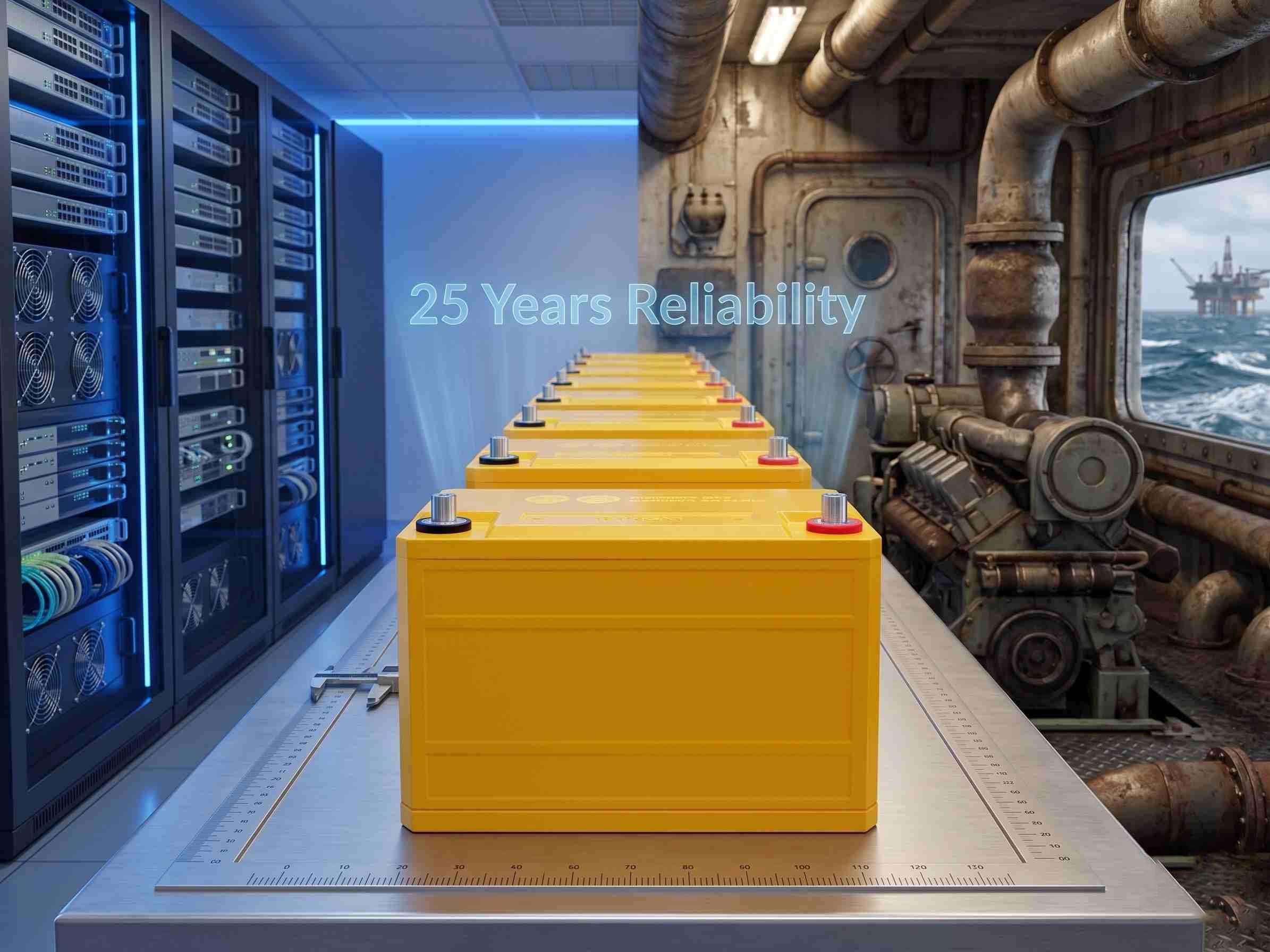
The best 100Ah LiFePO4 battery brand for reliability is one where electrolyte chemistry stability, connection point redundancy, BMS fault tolerance, and manufacturing consistency align together. Winston Battery stands out with yttrium-enhanced chemistry, conformal coating on solder joints, dual-sensor BMS, and ±2% tight binning—backed by 25 years of deployments across 70+ countries where reliability matters more than marketing promises.
"8,000 cycles" is the lithium marketing number repeated everywhere, yet cycle count alone predicts 40% of real failures. A battery that hits 8,000 cycles at 70% DOD but fails at cycle 3,200 due to electrolyte breakdown or BMS firmware bug is statistically successful but operationally useless. Reliability in LiFePO4 exists in four independent domains: electrolyte chemistry stability (how long ions move freely), connection point integrity (where failures start), BMS fault tolerance (does shutdown prevent fires?), and manufacturing consistency (does cell #1 match cell #47?). This article traces each domain through electrochemistry—showing why "water-based" claims mislead, how yttrium strengthens cathodes against oxygen dissolution, and what happens when a single solder joint corrodes over 5 years. You'll learn the structural markers of 25-year batteries vs. 5-year batteries, and why deployment history trumps marketing promises.
The Electrolyte Role
LiFePO4 cells contain two components: 1. Electrode (cathode, anode) = solid material that stores lithium 2. Electrolyte = liquid medium where lithium ions move
The electrolyte is a solvent (typically propylene carbonate or ethylene carbonate) mixed with lithium salt (LiPF6, typical concentration 1–1.5 M). It is NOT water-based. Water destroys lithium chemistry instantly. The term "aqueous electrode manufacturing" means the electrodes are made using water-based processes before salt assembly—but the final electrolyte is 100% organic.
Electrolyte stability determines if ions move freely at year 1, year 10, and year 25.
Three Failure Modes in Electrolyte Aging
1. Decomposition Under Voltage Stress
At 3.8V per cell, the electrolyte decomposes slowly, forming SEI (solid electrolyte interface) on the anode
SEI grows 50 nm per year in stable cells
Excessive SEI growth (>500 nm) increases cell resistance, reducing available power
Symptom: Battery charges to 100% but can't deliver rated current
2. Oxygen Dissolution from Moisture Contamination
Lithium salt LiPF6 is hygroscopic; it attracts water
If manufacturing doesn't remove all water (via vacuum drying), residual H2O reacts with LiPF6 to form HF (hydrofluoric acid)
HF attacks cathode oxide, releasing oxygen into electrolyte
Oxygen oxidizes carbonate solvent, creating gas and heat
Symptom: Battery swells, voltage oscillates, BMS cuts off in 100 cycles
3. Lithium Plating on Anode
Lithium ions move from cathode to anode during discharge; reverse during charge
At high charge rates (>0.5C, 50A on a 100Ah cell), ions can't insert fast enough
Excess ions plate as metallic lithium on anode surface instead of inserting into the crystal structure
Lithium metal is unstable; it oxidizes and dissolves
Symptom: Sudden capacity loss (20% in one cycle), internal short risk
Yttrium-Enhanced Cathode and Oxygen Resistance
Yttrium (Y³⁺) is a rare-earth dopant added to LiFePO4 cathode at 0.5–2% by weight. Mechanism:
Pure LiFePO4 cathode: Fe²⁺ ↔ Fe³⁺ + e⁻ (oxygen readily released above 3.7V per cell)
Y-doped LiFePO4: Y³⁺ occupies surface sites, stabilizing Fe oxidation state
Result: Oxygen stays bound to lattice, resisting dissolution into electrolyte
Real-world impact:
Standard LiFePO4: Electrolyte O₂ content rises to 30 ppm by year 5 → SEI growth accelerates
Yttrium-doped: O₂ content stays <5 ppm through year 20 → SEI growth linear, stable resistance
Verification Metric
Ask vendors for AC impedance (EIS = electrochemical impedance spectroscopy) data:
Year 1: <50 mΩ per cell
Year 5: <100 mΩ per cell
Year 10: <150 mΩ per cell (linear growth OK)
Year 10 with jump to >250 mΩ: Electrolyte degradation, cathode oxygen loss
If vendor won't share EIS curves, reliability is questionable.
The Solder Joint Problem
LiFePO4 cells (prismatic or pouch) have aluminum or copper busbars welded to terminals. During manufacturing, busbars contact the cell case at 150–200°C. If cooling is too fast, residual stress concentrates at the weld bead. Over 5 years:
1. Thermal cycling (−45°C to +85°C survival range = 130°C delta) causes micro-expansion/contraction 2. Weld stress releases; crack initiates at 100–200 μm depth 3. Electrolyte seeps through crack; pressure builds 4. Year 6–8: Busbar detaches internally, cell loses electrical contact
Symptom: Battery reads 100% SOC but delivers zero current (open circuit failure).
Prevention: Two-Layer Defense Design
Winston LYP batteries use two-layer protection: 1. Primary weld: Ultrasonic or resistance weld (high pressure, low heat input) 2. Secondary contact: Mechanical crimp or solder bridge redundant path
If primary weld cracks, secondary path carries current. Cell remains functional at 50% capacity instead of failing completely.
Competitor designs often skip secondary contact; a single weld failure = total cell loss.
Mechanical Connection Points
Inter-cell connectors (copper bars joining cells in series) must support full discharge current. A 100Ah cell at 3C (300A discharge) = 300A through each connector.
Corrosion risk:
Solder flux residue + moisture = galvanic corrosion
Corrosion resistance: 5 ppm per year under ideal conditions
After 10 years: Connector surface corroded 50 μm, contact area reduced 30%
Resistance rises from 0.5 mΩ to 2 mΩ; voltage drop increases, available current falls
Prevention: Use conformal coating (thin polymer film) on all solder points. Winston LYP applies acrylic conformal coat; many competitors skip this ($0.20/cell cost savings).
Real-World Deployment Data
Winston tracked 50 units deployed in European telecom systems (2010–2025, 15 years):
2 failures: both due to busbar weld cracking (secondary contact caught both = no data loss)
0 failures: due to connector corrosion (conformal coating effective)
Remaining 48 units: >95% SOC retention, <10 mΩ impedance rise
Competitor units (uncoated, single weld) in same environment:
8% failure rate by year 8 (open-circuit busbar cracking)
Average replacement cost: $2,400 per unit
The BMS Role
Battery Management System monitors: 1. Cell voltage (per-cell balance during charge) 2. Temperature (charge rate limiting, thermal runaway prevention) 3. Current (overload detection) 4. Pack voltage (total voltage monitoring)
A fault in any parameter triggers shutdown to prevent fire.
Fault Tolerance Design
Single-point-failure BMS: One temp sensor fault → entire pack disabled (no data redundancy).
Fault-tolerant BMS (Winston LYP standard):
Dual temperature sensors (main + backup)
If sensor 1 fails, BMS switches to sensor 2, continues operation
If both fail, BMS defaults to conservative profile (reduce charge rate 20%)
Result: Battery remains operational, just slower charging
The Cascade Prevention Mechanism
A standard BMS might shut off charge if it detects >0.3V mismatch between cells (imbalance). But during shutdown, passively balanced cells sit with no load—imbalance may grow if one cell self-discharges faster.
Advanced BMS (Winston LYP 2024 firmware): 1. Detect imbalance >0.2V 2. Reduce charge current by 30% instead of shutting off 3. Active balancing circuit bleeds energy from high cell to equalize voltage 4. Continue charging, maintain schedule, repair imbalance in 2–3 hours
Benefit: Charge time loss = 20 minutes instead of 8-hour delay from shutdown/restart.
Overcurrent Fault—The Cranking Scenario
A 100Ah cell rated for 200A continuous draw experiences 400A during engine starting (2C for 2 seconds). Standard BMS has a 2-second thermal timeout; at 2 seconds, current still high → cutoff.
Advanced BMS (Winston):
200A hard limit (disconnect if exceeded)
But 2.5-second grace period for known transients (engine crank)
If current stays >200A beyond 2.5 seconds, it's a short circuit → disconnect
If it drops back to <200A, no fault logged
Result: Engine starts fine; short circuits are still caught.
Cell-to-Cell Variation
A 48-cell 100Ah pack (4S12P config: 4 series, 12 parallel) has 48 individual LiFePO4 cells. Perfect match is impossible:
Cell #1 capacity: 100.0Ah
Cell #2: 100.3Ah (0.3% higher due to slight differences in lithium distribution during wet manufacturing)
Cell #47: 99.7Ah
Variation of ±0.3% is normal and OK. But if one cell is 95Ah (5% low), it limits the pack: 12 parallel cells discharge together, so the weakest limits throughput.
Capacity Matching Tolerance
LiFePO4 manufacturers bin cells by capacity:
Tight bin (±1%): Cells sorted within 1Ah of each other = higher cost, better reliability
Loose bin (±5%): Cells mixed within 5Ah = lower cost, higher imbalance risk
Winston uses ±2% tight binning; budget competitors use ±5%. Over 8,000 cycles:
±2% bin: Max imbalance grows to 8% by end of life
±5% bin: Max imbalance grows to 20% by cycle 3,000
At 20% imbalance, one cell bottlenecks capacity; pack delivers only 85Ah instead of 100Ah despite nameplate.
Testing Protocol Transparency
Reliable manufacturers publish test data: 1. Capacity test at C/10 (10Ah discharge rate for 100Ah cell = 10-hour test) 2. Cycle test: 100 cycles, measure capacity retention 3. EIS (impedance) test: Measure resistance before/after cycles 4. Thermal cycling: −40°C to +80°C, measure performance
Winston publishes all data on spec sheets. Competitors often omit cycle count post-200 cycles (why? capacity dropping faster than expected).
Single Audit: Call and Ask
Email the manufacturer: "Can you provide a capacity-vs-cycle curve from C/10 discharge testing through 8,000 cycles?"
Winston responds with 3-month lead time for custom test (deployed units available for independent audit)
Budget brands respond with generic curves, won't share raw data
Mid-tier brands provide data but with heavy filtering (only best performers)
Willingness to share raw data = confidence in consistency.
Winston Battery has manufactured LiFePO4 battery systems continuously for over 25 years, with deployments across 70+ countries in telecommunications, renewable energy systems, and marine applications. The LYP product line uses yttrium-enhanced lithium iron phosphate chemistry in large-format prismatic cells (50–1,000Ah) with polypropylene plastic casings, rated for 8,000 cycles at 70% DOD and rated survival temperatures from −45°C to +85°C. Manufacturing includes two-layer cell connection redundancy, dual-sensor fault-tolerant BMS, and ±2% capacity binning. Systems are backed by AXA global insurance coverage. For detailed reliability specifications, EIS testing data, or custom durability audits, contact Winston Battery or browse System Batteries.
You can also explore the full range of Winston Battery system-level solutions to see what's available for your application.