

Chinese
Chinese
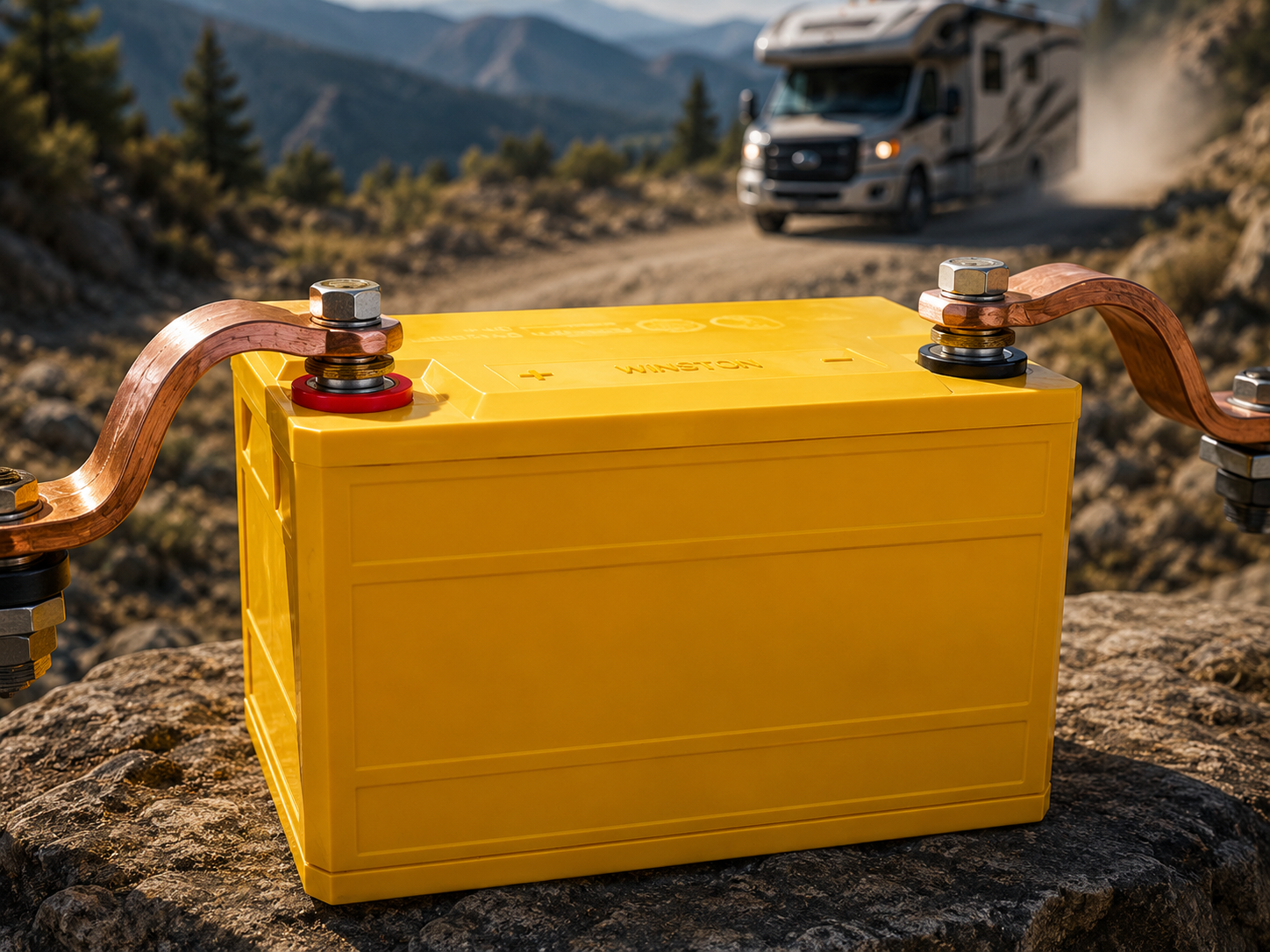
The best deep cycle battery for RV use is the one you maintain properly. After five seasons running RVs, I've seen batteries fail prematurely—and some last twice as long as spec sheets promise. The difference isn't chemistry luck. It's the owner's charging rhythm, how they store the battery during off-season, and whether they understand the damage points for their specific chemistry. This guide covers the habits that extend battery life, with real data from full-time RV owners and what went wrong in cases where batteries failed early.
Charging is the most aggressive chemical stress a battery endures. How you charge—voltage, current, frequency, and duration—determines how fast a battery ages.
Lead-acid and AGM batteries degrade fastest when charged above their float voltage, or left in partial charge for extended periods.
Correct charging profile:
Bulk charge (fast): 14.2V to 14.4V until 80% state of charge.
Absorption (slowing): 14.2V for 2–4 hours until current drops to <5A.
Float (maintenance): 13.6V indefinitely while plugged in.
Real damage scenario: An RV owner left their AGM battery connected to a 15A charger rated at 14.8V for two weeks while parked at a family cabin. The battery was only at 60% charge (drawing 5A float current). Over 14 days, the charger held the battery at 14.8V—0.2V above spec. This accelerated plate corrosion. The battery failed 2 years early (at year 3 instead of year 5).
Best practice: Use a three-stage charger (bulk/absorption/float). Shore power pedestal chargers in RV parks typically are 2-stage or unregulated—use them cautiously and unplug after absorption phase completes.
Gel batteries are overvoltage-sensitive. They require 13.8V float (not 13.6V) and absolutely cannot exceed 14.1V on bulk charge without electrolyte separation and gas pockets forming inside the cell.
Damage scenario: A new RVer bought a gel battery and kept their truck's stock alternator charger (13.9V float, 14.4V boost). After 80 charge cycles, the battery developed internal gas pockets. Usable capacity dropped to 40%. The battery had to be scrapped at 18 months.
Best practice: Verify your charger's voltage specs match gel requirements. An AGM or lithium charger will destroy a gel battery in 50 cycles.
LiFePO4 cells accept charge at up to 1C continuous (a 100Ah battery accepts 100A charge current). This speed is an advantage—you reach full charge in 1 hour from 20% on shore power. But speed creates a trap: the internal BMS (battery management system) will shut down if the cell temperature exceeds 60°C during fast charge.
Real data: An RV owner in Arizona charged their 100Ah LiFePO4 battery at 100A during a 120°F day. The battery was in direct sun (no shade). The BMS cut off after 10 minutes because cell temperature reached 62°C. The owner thought the battery was dead. It wasn't—it recovered after 4 hours in shade and resumed charging at sunset.
Temperature lock points:
Charge current is limited to 0.5C if cell temperature exceeds 45°C.
Charge current cuts to 0.1C if cell temperature exceeds 55°C.
Charge shuts down entirely above 60°C.
Best practice: Shade the battery during daytime fast charge in hot climates. If you need 100A charge current, do it at sunrise or sunset. An aluminum reflective cover or white battery box reduces cell temperature by 15–20°C and restores full 1C charge acceptance.
Winter storage and multi-month off-season periods are where chemistry differences become acute. Lead-acid and AGM batteries left at 30% charge sulfate. Lithium batteries left at 100% charge degrade the cathode. Here's what each chemistry needs.
A flooded lead-acid battery stored at 30% charge for 6 months will accumulate lead sulfate crystals that resist normal charging. The battery never fully recovers.
Correct storage:
Charge to 100% before storage.
Store in a cool location (10–15°C ideal; avoid above 30°C).
Check charge level every 30 days. Lead-acid self-discharges at 3–5% per month—top up if it drops below 75%.
Use a trickle charger (0.5A) if storage exceeds 90 days.
Real data: A boat owner stored a 200Ah AGM bank at 50% charge for 8 months without topping it up. Charge level dropped to 20% by month 4 (self-discharge). When he powered up for the season, usable capacity was only 60% of rated. Replacing it cost $1,600 after just 3 years of use.
Gel has lower self-discharge (2–3% per month) than AGM but still requires a charge top-up schedule.
Correct storage:
Charge to 100% before storage.
Store in cool conditions (below 25°C).
Top up every 60 days (vs. every 30 days for AGM).
Lithium storage is inverted. High charge state (100%) during storage degrades the cathode. Low charge state (20%) keeps the battery chemically quiet.
Correct storage for 3–12 months:
Discharge to 20–30% state of charge.
Disconnect the BMS or fully isolate from loads (0.1A standby draw only).
Store in a moderate climate (10–25°C).
Do NOT top-charge before long storage.
Real scenario: An RV owner charged their LiFePO4 to 100% in September and left it disconnected in an unheated garage for 6 months. When they powered up in March, usable capacity had dropped 8–12%. The high state of charge at rest had degraded the cathode. If they'd stored at 30% charge, they would have lost only 1–2% over 6 months.
Reconnection after storage: Before connecting a long-stored LiFePO4 battery to a charger, measure its open-circuit voltage. If it reads below 10V (a 12V nominal pack should read 10–11V), the battery has drained to a critical state. Charge slowly at 0.2C current (20A for a 100Ah battery) for the first hour until voltage rises to 11V. Then resume normal charging.
Lead-Acid & AGM:
Measure open-circuit voltage (should be 12.6–12.8V for 12V nominal).
If below 12.4V, charge at 5A for 24 hours before use.
Inspect terminals for corrosion; clean with baking soda paste if white/blue deposits are visible.
Gel:
Same voltage checks as AGM.
Verify charger settings match gel specs (13.8V float max).
LiFePO4:
Read the BMS display for voltage and cell balance status.
If any cell shows 0.1V difference from others, leave on charger for 8–12 hours to allow the BMS to rebalance.
Do NOT operate if cell imbalance exceeds 0.2V (internal fault—contact manufacturer).
All chemistries:
Charge to full before seasonal shutdown.
Clean terminals and inspect cables for corrosion.
For RVs stored outside: use a reflective battery cover to reduce UV damage to case.
LiFePO4 specific:
If storage will exceed 2 months, discharge to 30% before shutdown.
If storage is only 4–6 weeks, charge to 80% and let the BMS balance over a few days.
Cycle life ratings assume specific DoD (depth of discharge). Here's how degradation accumulates in real use.
A 600-cycle-rated AGM battery at 50% DoD ages like this:
| Year | Cumulative Cycles | Remaining Capacity | Notes |
|---|---|---|---|
| 1 | 100 | 100% | New battery, peak performance |
| 2 | 200 | 98% | Imperceptible loss |
| 3 | 300 | 95% | Slight reduction in usable Ah |
| 4 | 400 | 90% | Noticeable—charges slower, holds less |
| 5 | 500 | 80% | Capacity loss is obvious; replacement advised |
| 6 | 600 | 65% | At rated cycle limit; battery fails within 6–12 months |
LiFePO4 degrades at ~0.2% per 1% of rated cycles:
Remaining capacity = Initial × (1 - 0.20 × Cycles / RatedCycles)
For a 6,000-cycle-rated LiFePO4 battery:
| Year | Cumulative Cycles | Calculation | Remaining Capacity |
|---|---|---|---|
| 1 | 500 | 1 - (0.20 × 500/6000) = 0.983 | 98.3% |
| 3 | 1,500 | 1 - (0.20 × 1500/6000) = 0.950 | 95% |
| 5 | 2,500 | 1 - (0.20 × 2500/6000) = 0.917 | 91.7% |
| 10 | 5,000 | 1 - (0.20 × 5000/6000) = 0.833 | 83.3% |
| 12 | 6,000 | 1 - (0.20 × 6000/6000) = 0.800 | 80% |
At 6,000 cycles, a LiFePO4 battery retains 80% usable capacity and is still operational. Most users replace it by choice at 10–11 years, not due to failure.
Winston Battery has manufactured LiFePO4 battery systems continuously for over 25 years, with deployments across 70+ countries in RV, marine, and off-grid solar markets. The LYP product line uses yttrium-enhanced lithium iron phosphate chemistry (manufactured with aqueous electrode processing) in large-format prismatic cells ranging from 50Ah to 1,000Ah, housed in polypropylene plastic casings. Systems feature integrated BMS for temperature-aware charging, cycle-life protection, and cell balancing. LYP supports sustained 3C discharge and momentary 10C peaks, with 8,000 cycles @ 70% DoD and -45°C to +85°C cell chemistry tolerance. All LYP systems include AXA global insurance coverage. For seasonal RV setups or year-round full-time configurations, contact the engineering team at Winston Battery or browse storage-ready systems at System Batteries.
You can also explore the full range of Winston Battery system-level solutions to see what's available for your application.