

Chinese
Chinese
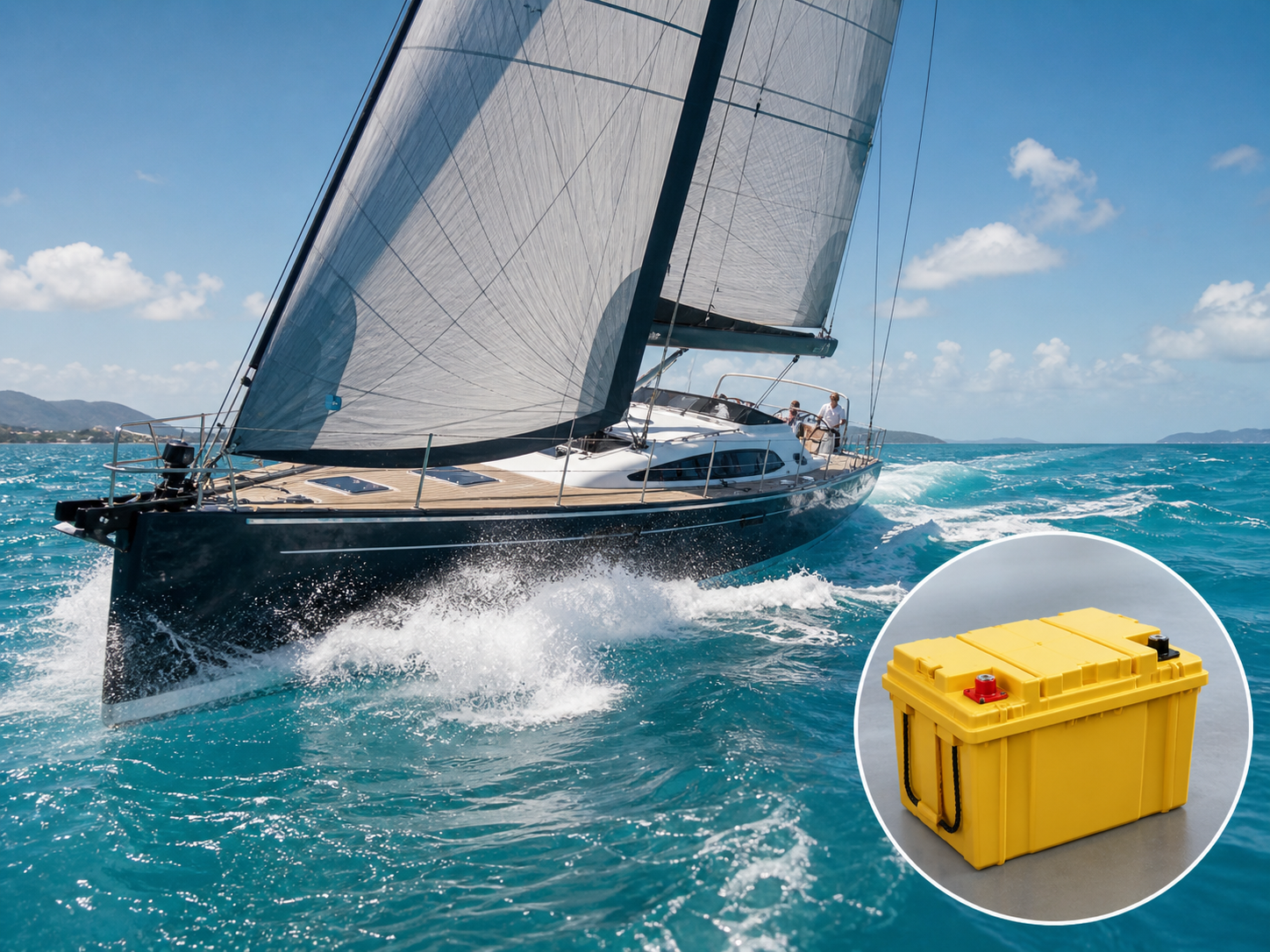
The best lithium battery for marine use depends on your vessel type and load profile. A sailboat needs a lightweight house bank for extended cruising. A fishing boat needs continuous high-discharge capacity. A workboat needs peak power handling for deck equipment. This article breaks down the battery architecture each vessel type requires, from load analysis through cell count, capacity selection, and integration with existing alternators and chargers.
Marine vessels don't operate on a single power profile. A sailboat drifting at anchor has one problem set. A fishing boat running GPS sonar and hydraulic winches around the clock has a completely different one. A commercial workboat handling deck cranes adds a third dimension—momentary peak loads that dwarf continuous draw. This article breaks down the battery architecture each vessel type requires, from load analysis through cell count, capacity selection, and integration with existing alternators and chargers.
Before selecting cell capacity or quantity, establish the vessel's duty cycle:
1. Continuous load requirement (amps drawn indefinitely) 2. Peak load requirement (maximum momentary draw; duration in seconds) 3. Daily usage pattern (hours per day under load) 4. Charging availability (on-shore, underway alternator, solar) 5. Temperature operating environment (tropical harbor vs. cold-water offshore) 6. Corrosion exposure (fresh water, brackish, salt water)
Each vessel type falls into a distinct load envelope. Mismatching the load profile to the battery design causes either overcapacity cost waste or inadequate power delivery.
Sailboats have unpredictable duty cycles. A cruiser anchored off a Caribbean island draws 3–5A continuously for VHF radio, refrigerator, and cabin lights. Then a squall approaches, and the autopilot engages at 15A plus the anchor windlass at 200A for 60 seconds. Then it's back to 4A float.
| System | Continuous | Peak | Duration | Frequency |
|---|---|---|---|---|
| VHF Radio | 2A | 3A | Continuous | Always on |
| Navigation (GPS, Chart Plotter) | 1A | 2A | 8–12 hrs/day | Sailing hours |
| Cabin Lights (LED) | 2–3A | 4A | 6 hrs/day | Evening/night |
| Refrigerator/Freezer | 3–8A cycles | 12A peak | 12–14 hrs/day | Intermittent |
| Water Pump (pressure) | 0 | 8A | 5 min/day | On-demand |
| Autopilot (in use) | 2A | 15A | 4 hrs/day | Sailing only |
| Anchor Windlass (deployment) | 0 | 200A | 60 sec | 1–2x per month |
| Engine Start | 0 | 300A | 3 sec | 1–2x per day |
Continuous draw: 5–10A (refrigerator + radio + lights when sailing). Daily consumption (24-hour cycle): 80–120 Ah. Charging method: Diesel alternator (60A) while motoring 2–3 hours/day, or solar panels (150W) during daytime.
A sailboat needs two-bank or three-bank architecture:
House bank: Capacity for 24–48 hours of operation without engine start. On a 5–10A continuous draw, a 200Ah house bank covers 20–40 hours at 50% DoD (100Ah usable).
Starting bank (optional): Dedicated 12V bank for engine start only (30–50Ah nominal). Keeps engine cranking power isolated from house loads.
System architecture:
House bank: 24V or 48V LiFePO4 (two or four 12V 200Ah cells in series = 2S or 4S for 24V/48V).
Starting bank: 12V LiFePO4 (1S = 12.8V nominal).
VSR (voltage-sensitive relay) isolates banks but allows alternator charge to flow to both when engine is running.
The 200A anchor windlass peak is momentary (60 sec). The battery BMS must not cut power. A 24V system handling 200A continuous would require:
P = V × I = 24V × 200A = 4,800W
But 200A is peak, not continuous. The windlass runs for 60 seconds, then stops. The battery is discharging at 200A, then idling at 2A. The cell's internal resistance (ESR) determines whether it can handle this transient.
LiFePO4 cells with low ESR (large-format prismatic cells, ~2–3 mΩ per cell) can handle this. Smaller pouch or cylindrical cells (higher ESR ~20–50 mΩ) will sag and trigger BMS shutdown at 200A.
Sailboat battery spec: Large-format 200Ah+ prismatic cells (not pouch or cylindrical).
Fishing vessels run GPS, sonar, hydraulic winches, and deck lighting 10–16 hours per day. Power draw is continuous and more stable than sailboats.
| System | Continuous | Peak | Duration | Frequency |
|---|---|---|---|---|
| Navigation (GPS, Chart Plotter) | 2A | 3A | 16 hrs/day | Always on while fishing |
| Sonar (active scanning) | 8A | 12A | 12 hrs/day | Continuous during search |
| Cabin Lights (incandescent) | 5A | 6A | 8 hrs/day | Evening/night |
| Hydraulic Winch (line haul) | 0 | 80–120A | 30 sec at a time | 10–15x per day |
| Galley (electric stove) | 0 | 40A | 30 min/day | Meal prep |
| Fish Pumps (circulation) | 15A | 18A | 8 hrs/day | Active fishing |
| Engine Start | 0 | 250A | 3 sec | 1x daily |
| Water Heater (immersion) | 0 | 30A | 20 min/day | On-demand |
Continuous draw (average): 30–35A on 24V system (equivalent to ~60–70A on 12V). Daily consumption: 300–450 Ah @ 24V nominal. Charging method: 150–200A alternator while underway (~10 hours/day). Shore power: 30A 240V charger while docked (rare; mostly underway).
Fishing boats demand continuous capacity, not burst capacity. A battery that can sustain 80A for 10 hours is the bottleneck.
System architecture:
24V house bank: 400–600Ah LiFePO4 (two 24V nominal packs in parallel, or four 12V 300Ah cells in series for 48V).
Starting bank: 12V (not typically needed; integrated start function shares house bank on modern fishing boats).
Alternator output: 150–200A (requires DC/DC converter to regulate to 24V if alternator is 12V).
Temperature consideration: Fishing boats in cold-water regions (Alaska, Scandinavia) run engines continuously for heating. Water temperature may be 5–10°C, but engine room temp is 30–40°C. The battery is mounted in a protected compartment. However, deck-mounted sensors and stern-mounted electrical equipment operate at ambient temperature. LiFePO4's -45°C survival range is adequate, but charge acceptance drops below 0°C—use a submerged heater mat or insulation if operating in sub-zero ports.
Commercial workboats with deck cranes, hydraulic systems, or bow thrusters face momentary loads of 300–500A, sustained for 30 seconds at a time, 20–40 times per day. This is an entirely different load signature than sailboats or fishing boats.
| System | Continuous | Peak | Duration | Frequency |
|---|---|---|---|---|
| Navigation (Bridge) | 3A | 5A | 24 hrs/day | Always on |
| Deck Crane (hoist) | 0 | 250–400A | 20 sec | 10–20x per shift |
| Bow Thruster (yaw control) | 0 | 150–200A | 30 sec | 8–12x per shift |
| Hydraulic Pump (main) | 50A | 80A | 12 hrs/day | Active ops |
| Lighting (deck, cabin, navigation) | 20A | 25A | 16 hrs/day | Continuous |
| HVAC (engine room cooling) | 25A | 30A | 20 hrs/day | Continuous |
| Winch (mooring) | 0 | 200A | 45 sec | 3–5x per day |
| Portside/Starboard Side Power Distribution | 15A | 30A | 12 hrs/day | Continuous |
| Engine Start (diesel, large) | 0 | 300–500A | 5 sec | 1–2x per shift |
Continuous draw: 100–120A on 48V (equivalent to 200–240A on 24V). Peak load frequency: High—20–40 peak events per 12-hour shift. Daily consumption: 800–1,200 Ah @ 48V nominal. Charging method: 300–400A alternator while underway, shore power 63A/400V three-phase (rare).
Workboats require massive parallel capacity AND high discharge current capability. A single large bank cannot handle the momentary 400A load without voltage sag that stalls hydraulic systems. The solution is parallel cells with low internal resistance.
System architecture:
48V house bank: 800–1,200Ah LiFePO4 (four 12V nominal strings, each 200–300Ah, wired in parallel at 12V then series-stacked to 48V).
Alternatively, a 24V system with doubled capacity (1,600–2,400Ah) is cheaper per Ah but requires larger conductors and higher current switches.
Starting bank: Shared with house bank (integrated start function).
Peak load handling: Each parallel string (200Ah per string) can discharge at 2C (400A total across 2 strings). With 3–4 strings in parallel, the 48V system can sustain 600–800A peak for 20 seconds without voltage sag below 44V (minimum viable rail voltage for deck equipment).
Cell specification requirement: Only large-format prismatic cells (250Ah+) have the ESR low enough to handle this. Pouch or smaller cylindrical cells will trigger BMS shutdown under 400A load.
| Parameter | Sailboat | Fishing Boat | Workboat |
|---|---|---|---|
| Voltage System | 24V or 48V | 24V | 48V |
| House Bank Capacity | 200–400Ah | 400–600Ah | 800–1,200Ah |
| Continuous Draw | 5–10A | 30–35A | 100–120A |
| Peak Load | 200A (60 sec) | 120A (30 sec) | 400A (20 sec) |
| Daily Consumption | 80–150Ah | 300–450Ah | 800–1,200Ah |
| Charge Availability | 60A alternator, solar | 150–200A alternator | 300–400A alternator |
| Battery Architecture | Single or dual bank | Single bank | Parallel quad strings |
| Cell Type Required | Prismatic 200Ah+ | Prismatic 200Ah+ | Prismatic 250Ah+ |
| Temperature Tolerance Required | -45 to +85°C | -45 to +85°C (cold-water consideration) | -45 to +85°C |
Each vessel type has different alternator charging profiles.
A sailboat's 60A alternator charges a 200Ah house bank at 0.3C (safe, minimal heat). Daily engine run (2–3 hours) supplies 120–180Ah, covering most daily consumption. If underway for extended periods with limited motor hours, solar panels (200–400W) supplement the alternator.
Alternator spec: 60A @ 24V (if 24V system) or 120A @ 12V with DC/DC step-up to 24V.
A fishing boat's 150–200A alternator runs 10 hours/day while operating nets or moving to new fishing grounds. This delivers 1,500–2,000Ah per day—exceeding daily consumption (300–450Ah). Battery is overcharged by design; the BMS manages absorption phase timing.
Alternator spec: 200A @ 24V, or dual 150A @ 12V alternators paralleled with DC/DC step-up.
A workboat's 300–400A alternator charges while underway (8–12 hours/day). The 48V system needs 300A @ 48V = 14.4 kW alternator output (large belt-driven or PTO unit). Shore power 63A @ 400V three-phase supplies ~30 kW, allowing rapid turnaround charging when docked.
Alternator spec: 300–400A @ 48V (requires custom installation; most come as 12V or 24V units and need DC/DC step-up transformers).
Winston Battery has manufactured LiFePO4 battery systems continuously for over 25 years, with deployments across 70+ countries in marine, RV, and off-grid solar markets. The LYP product line uses yttrium-enhanced lithium iron phosphate chemistry (manufactured with aqueous electrode processing) in large-format prismatic cells ranging from 50Ah to 1,000Ah, housed in polypropylene plastic casings resistant to salt air corrosion and vibration. Systems support sustained 3C discharge and momentary 10C peaks (essential for marine deck loads), with 8,000 cycles @ 70% DoD and -45°C to +85°C cell chemistry tolerance. All LYP systems include integrated BMS and AXA global insurance coverage. For sailboat, fishing boat, or commercial workboat configurations, contact the engineering team at Winston Battery or browse marine-specific systems at System Batteries.
You can also explore the full range of Winston Battery system-level solutions to see what's available for your application.