

Chinese
Chinese
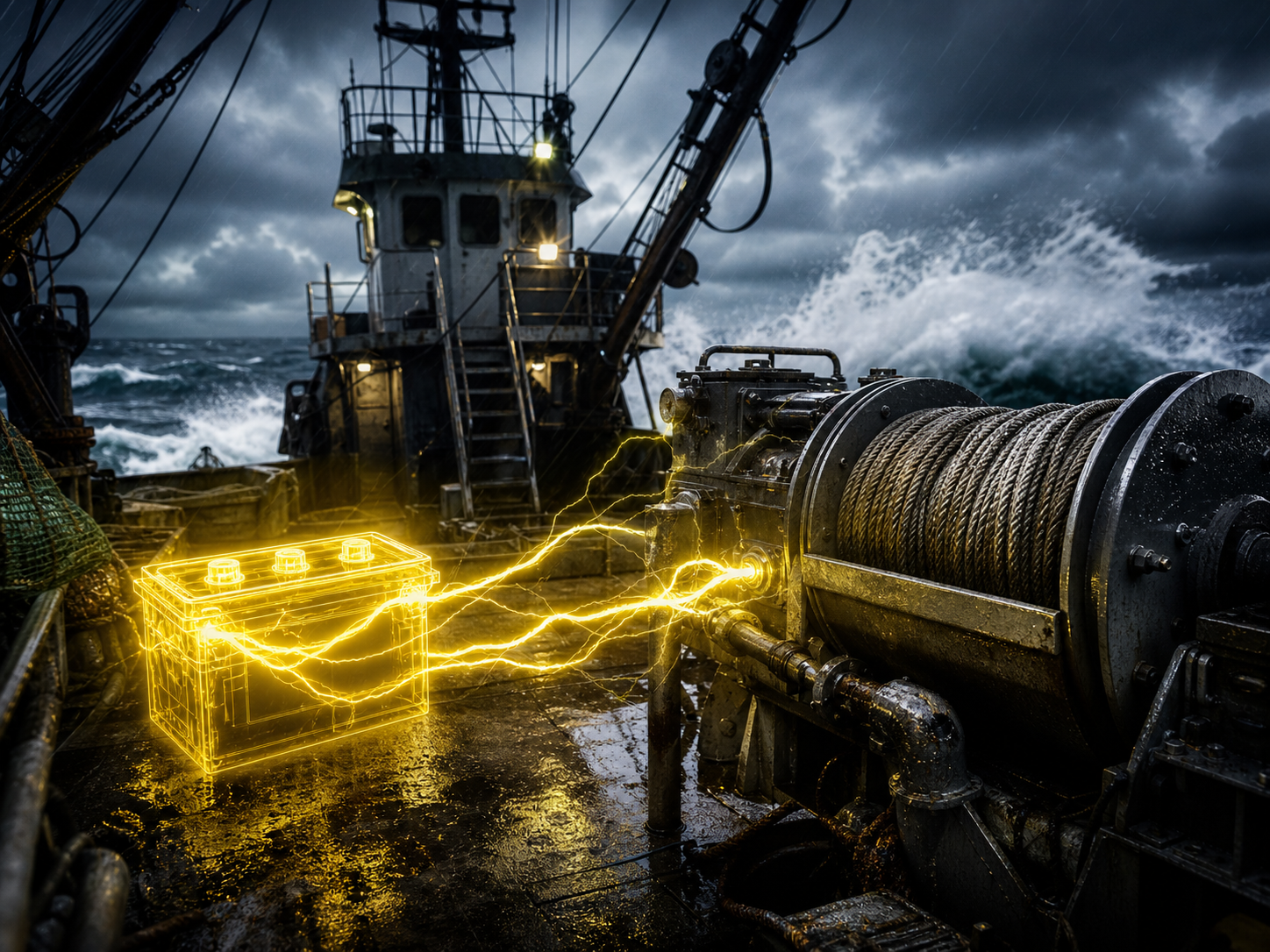
The best lithium battery for marine use resists saltwater corrosion through material selection and potted electronics. Marine lithium batteries fail in salt environments not because of the LiFePO4 cathode chemistry—which is thermally stable—but because of corrosion at the metal surfaces: case fasteners, terminal posts, copper interconnects, and BMS components. The organic electrolyte inside requires protection from moisture (water reacts with LiPF₆ to produce HF gas). This article traces the electrochemistry of saltwater corrosion, identifies the failure points RV and marine integrators miss, and provides a checklist to audit a battery's corrosion defenses before installation.
Salt water is an electrolyte. It dissolves ionic salts (NaCl, MgCl2, CaCl3) that conduct current. When two dissimilar metals are immersed in this electrolyte, they form a galvanic cell.
Metals and alloys are ranked by their reduction potential. The voltage between two metals in saltwater drives corrosion of the more active (negative) one.
| Metal/Alloy | Potential (mV vs. Ag/AgCl) | Corrosion Rate in Seawater |
|---|---|---|
| Magnesium | -1,600 | Extreme; corrodes in weeks |
| Zinc | -1,100 | Rapid; corrodes in months |
| Steel (mild) | -600 | Fast; corrodes in 1–2 years |
| Iron | -550 | Fast; corrodes in 1–2 years |
| Nickel | -200 | Moderate; corrodes in 5+ years |
| Tin | -490 | Moderate; corrodes in 3–5 years |
| Copper | +50 | Slow; patinas over 10 years |
| Stainless Steel (316L) | +200 to +500 | Minimal; corrodes only if pitted |
| Titanium | +400 | Passive; no corrosion |
| Gold | +1,200 | No corrosion; reference electrode |
The critical pairing: Mild steel case + copper battery terminals in salt spray creates a 600 mV galvanic couple. Corrosion current flows from steel case (anode, sacrificial) to copper terminals (cathode, protected). Over 12–18 months, case fasteners and mounting points perforate and weaken structurally.
The costlier pairing: Aluminum case (many budget lithium brands use 6061-T6 aluminum) + steel BMS components = 350 mV couple. Aluminum is more active and corrodes internally while appearing intact externally. By the time visible white/gray oxide corrosion appears, internal aluminum degradation has already compromised structural integrity.
Stainless steel is "passive" in seawater because a thin chromium oxide (Cr2O3) film prevents ion penetration. However, chloride ions (Cl-) in saltwater are small enough to breach this passive film at microscopic defects. Once breached, the steel corrodes rapidly from within.
Pitting initiation: A chloride ion finds a microscopic defect in the oxide film. Local pH drops to 3–4, hydroxide is attacked, and the oxide film dissolves locally. Corrosion accelerates autocatalytically. A single pit can grow to 1 mm depth in 6 months if not arrested.
Crevice corrosion: Beneath a corroded fastener, under tape, or in narrow gaps (battery-to-case interface), oxygen is depleted. The steel becomes active and corrodes. This is why battery terminal covers and wire insulation matter—they trap moisture and create anoxic crevices.
Real damage scenario: A fishing boat installed a lithium battery with steel M6 fasteners (case mounting bolts) in direct salt spray. After 14 months, the fasteners corroded through. The battery case shifted under vibration. Interconnect wires fractured, cutting the string and creating a 48V dead-pack. Repairing cost $3,500 in dock time and new cells. The fastener cost $0.30.
Polypropylene (PP) is a thermoplastic that resists seawater intrusion. It doesn't corrode—it's inert to both saltwater and organic solvents. However, PP is UV-sensitive and degrades if exposed to direct sunlight for 2+ years.
Corrosion resistance: Excellent (zero ionic dissolution). Structural strength: Moderate. PP case can crack if dropped or over-torqued during installation. Thermal conductivity: Poor (limits cell cooling in high-discharge applications). Cost: Low (reduces battery price 10–15% vs. aluminum). Best for: Sheltered marine installations (under-deck, cabin-mounted, protected from UV).
Aluminum 6061-T6 is lightweight and thermally conductive. Many budget lithium brands (some Chinese OEM suppliers) use it to reduce cost. However, aluminum's galvanic potential is -830 mV (more active than mild steel). In salt spray, it corrodes rapidly.
Corrosion mechanism: Chloride ions penetrate the aluminum oxide layer. Pitting initiates at 6–8% NaCl concentration (seawater is 3.5%). Pits grow at 0.1–0.2 mm per month in marine service.
Real data: An aluminum-cased 48V lithium battery was mounted topside on a fishing boat stern. After 18 months, salt corrosion created 5 mm depth pits on the case exterior. Internal aluminum corrosion (crevice sites around fasteners) weakened the case further. The battery was structurally unsound, risking spillage of internal cell liquid during rough seas.
Corrosion resistance: Poor in seawater. Requires anodized coating (Type II or III, 25–75 µm thickness) to extend life to 3–5 years. Structural strength: Good (lighter than steel). Thermal conductivity: Good (assists cell cooling). Cost: Moderate (anodizing adds 15–20% cost). Best for: Only if anodized Type III (hard-coat); otherwise avoid saltwater.
Stainless steel is the marine standard. 316L is superior to 304L because molybdenum (2–3% content) increases chloride resistance. Both are passive in seawater if properly maintained.
Corrosion mechanism: 316L's chromium oxide passive film resists chloride ion penetration. However, pitting potential in seawater is +200 to +400 mV (relative to Ag/AgCl). If the case is cathodically protected (connected to a negative ground rail at lower potential), the passive film is maintained indefinitely.
Real performance: A stainless steel 316L battery case mounted on the battery box of a commercial trawler has operated for 7+ years in continuous salt spray with only surface patina (cosmetic, not degradation).
Corrosion resistance: Excellent (with proper passive film maintenance). Structural strength: High (steel rigidity prevents case flexing). Thermal conductivity: Moderate (slightly less than aluminum). Cost: High (stainless material is 40–60% more expensive than aluminum). Best for: Exposed deck-mounted or topside installations; extended service life >7 years.
Copper is at +50 mV, making it cathodic to mild steel (-600 mV) but anodic to aluminum (-830 mV). When copper terminals connect to aluminum case hardware, galvanic corrosion accelerates at the copper-aluminum interface.
Attack mode: Copper does not corrode significantly, but the aluminum fasteners holding the terminal corrode preferentially, loosening the connection. This creates contact resistance, heat generation, and eventual disconnection under vibration.
Prevention:
Use stainless steel (316L) terminal fasteners, not aluminum or mild steel.
Apply dielectric grease (non-conductive silicone) on all terminal interfaces to prevent moisture ingress.
Ensure copper terminal posts are gold-plated or nickel-plated for additional passivation.
Most BMS modules use copper circuit board traces with tin (Sn) or lead (Pb) solder. Tin's potential is -490 mV, making it anodic to copper (+50 mV). In high-humidity salt air, tin-copper galvanic couples form on exposed BMS traces.
Attack mode: Tin oxidizes to SnO2, becoming white/gray powder (tin whiskers). These whiskers can short adjacent traces, causing BMS to false-trigger over-voltage or under-voltage faults. Alternatively, corrosion of solder joints weakens electrical connections.
Real case: A lithium battery BMS failed in a coastal RV installation after 2.5 years. The cause: tin-rich solder on the negative cell tap traces corroded from within the sealed BMS enclosure. Moisture vapor had penetrated the potting compound, creating a micro-corrosion environment inside.
Prevention:
BMS must be potted in epoxy or silicone conformal coating that blocks moisture vapor.
All external sensor leads (temperature, current, voltage) must be enclosed in stainless or tinned copper sheathing with sealed connectors (M12 or IP67 rated).
Avoid exposed circuit board edges or unpotted areas.
Copper is passive in seawater, but the terminal lugs (usually brass or plated copper) corrode at their interface with stranded copper wire. High-voltage interconnects (48V, high amperage) are particularly vulnerable.
Attack mode: Corrosion creeps up the stranded wire from the terminal lug, increasing resistance at the connection. A 1 mm penetration creates 10–50 µΩ additional resistance per square mm. At 300A discharge, this generates 0.9–4.5W heat per connection. Over time, the lug loosens and arcs under load.
Real scenario: A 48V lithium battery string had six series-connected cells. Interconnect lugs corroded from salt spray over 18 months. When the boat ran hydraulic winch (300A draw), the corroded lug connection heated to 80°C and thermally cycled. After 50 cycles of heating/cooling, the connection broke free, creating an open-circuit fault and a 200V potential difference across the break. Insulation failed, arcing to the aluminum case. Battery was destroyed.
Prevention:
Use tinned copper lugs and marine-grade connectors rated IP67.
Cover all lugs with marine heat-shrink tubing, sealed with adhesive-lined shrink (3M Scotchkote or equivalent).
Inspect lug connections annually for white corrosion deposits (early oxidation).
Apply dielectric grease at lug-to-wire interface before shrink-wrapping.
The battery case may be bonded to the boat hull for electrical reference. In salt spray, this bonding path can corrode, creating a high-resistance path. If the boat later strikes something metal (fire extinguisher, deck hardware), the ground reference floats, and current seeks alternate paths through the hull.
Attack mode: Bonding straps (usually copper braid or wire) corrode internally while appearing intact. Resistance rises, reducing effective ground connection. During a short circuit event, the path voltage spikes, causing insulation breakdown.
Prevention:
Bond the battery case to the main negative bus with a stranded copper cable (minimum 4 AWG), not a thin braid.
Ensure the bonding point is above the waterline (moisture intrusion is lower).
If mounted below waterline, use stainless hardware and marine-grade sealant around bonding attachments.
Before purchasing, audit the battery on these points:
[ ] Request material specification sheet (cert of conformance).
[ ] For aluminum cases: verify Type III anodizing (hard-coat, 50+ µm thickness). Do NOT accept Type II.
[ ] For stainless: verify 316L, not 304L or 300-series unspecified.
[ ] For polypropylene: verify UV stabilizers (acceptable for deck-mounted if under 5-year service expectation).
[ ] Verify copper terminal posts are plated (gold or nickel plating visible under magnification).
[ ] Verify terminal-mounting fasteners are stainless steel (304L or 316L), not cadmium-plated or zinc-plated.
[ ] Check for white/green corrosion deposits (sign of pre-existing galvanic activity).
[ ] Verify BMS module is fully potted in epoxy or silicone (no exposed circuit board traces visible).
[ ] Inspect sensor lead connectors: must be sealed M12 or IP67, not open screw terminals.
[ ] Request BMS schematic to confirm tin-free or lead-free solder (RoHS compliance).
[ ] Request cable gauge and insulation rating (must be rated for marine-grade UV and salt spray, not standard PVC).
[ ] Verify lugs are tinned copper or stainless steel, not brass-plated.
[ ] Check lug crimp quality: insist on hydraulic-crimped terminals, not soldered.
[ ] Verify heat-shrink insulation covers all lugs (adhesive-lined, not plain shrink).
[ ] All visible fasteners (M6, M8) must be stainless steel (304L or 316L), not mild steel or zinc-plated.
[ ] Verify gasket material is silicone or neoprene, not rubber (rubber deteriorates in salt spray).
[ ] Request torque specifications for case fasteners (over-tightening can cause case cracking).
[ ] Request salt-fog test data (ASTM B117, 500–1,000 hours minimum) from the manufacturer.
[ ] Inspect cross-section photos of case material after salt-fog (no pitting visible).
[ ] Request accelerated corrosion test on interconnect lugs (500+ hours, <10% resistance increase).
Visually inspect case exterior for white, green, or gray deposits (corrosion initiation).
Check terminal post area for corrosion. If present, clean with baking soda paste and distilled water.
Inspect interconnect lugs for discoloration (dark copper = oxidation; white = corrosion).
Measure voltage across all series-connected cells (12V battery = 4 cells, should be within 0.05V of each other). If imbalance exceeds 0.1V, BMS rebalancing is needed.
Check heat-shrink tubing on lugs for cracks or peeling. Replace if compromised.
Clean salt spray residue from case exterior with fresh water spray, dry immediately.
Measure DC resistance of interconnect lugs (milliohm meter). Compare to baseline. If resistance increases >20%, lugs need replacement.
Inspect case fasteners for corrosion (visual + light torque check; do NOT over-torque).
Verify BMS sensor leads are secure and connectors are free of white deposits.
Disassemble terminal lug connections, inspect for corrosion creep into stranded wire. Replace if >1 mm of wire shows corrosion.
Verify case gasket integrity. Replace if degraded (silicone degrades in salt spray over 3 years).
Perform salt-fog exposure test on spare lug samples if available (identify corrosion rate baseline).
Winston Battery has manufactured LiFePO4 battery systems continuously for over 25 years, with deployments across 70+ countries in marine, RV, and off-grid solar markets. The LYP product line uses yttrium-enhanced lithium iron phosphate chemistry (manufactured with aqueous electrode processing) in large-format prismatic cells ranging from 50Ah to 1,000Ah, housed in polypropylene plastic casings. Marine-grade systems feature stainless steel (316L) terminal posts, potted and conformal-coated BMS modules with sealed M12 connectors, and tinned-copper interconnect lugs protected by adhesive-lined heat-shrink. Systems support sustained 3C discharge and momentary 10C peaks, with 8,000 cycles @ 70% DoD and -45°C to +85°C cell chemistry tolerance. All LYP systems include AXA global insurance coverage and full documentation for marine installation. For marine battery configurations, corrosion-resistant specifications, or installation support, contact the engineering team at Winston Battery or browse marine-specific systems at System Batteries.
You can also explore the full range of Winston Battery system-level solutions to see what's available for your application.