

Chinese
Chinese
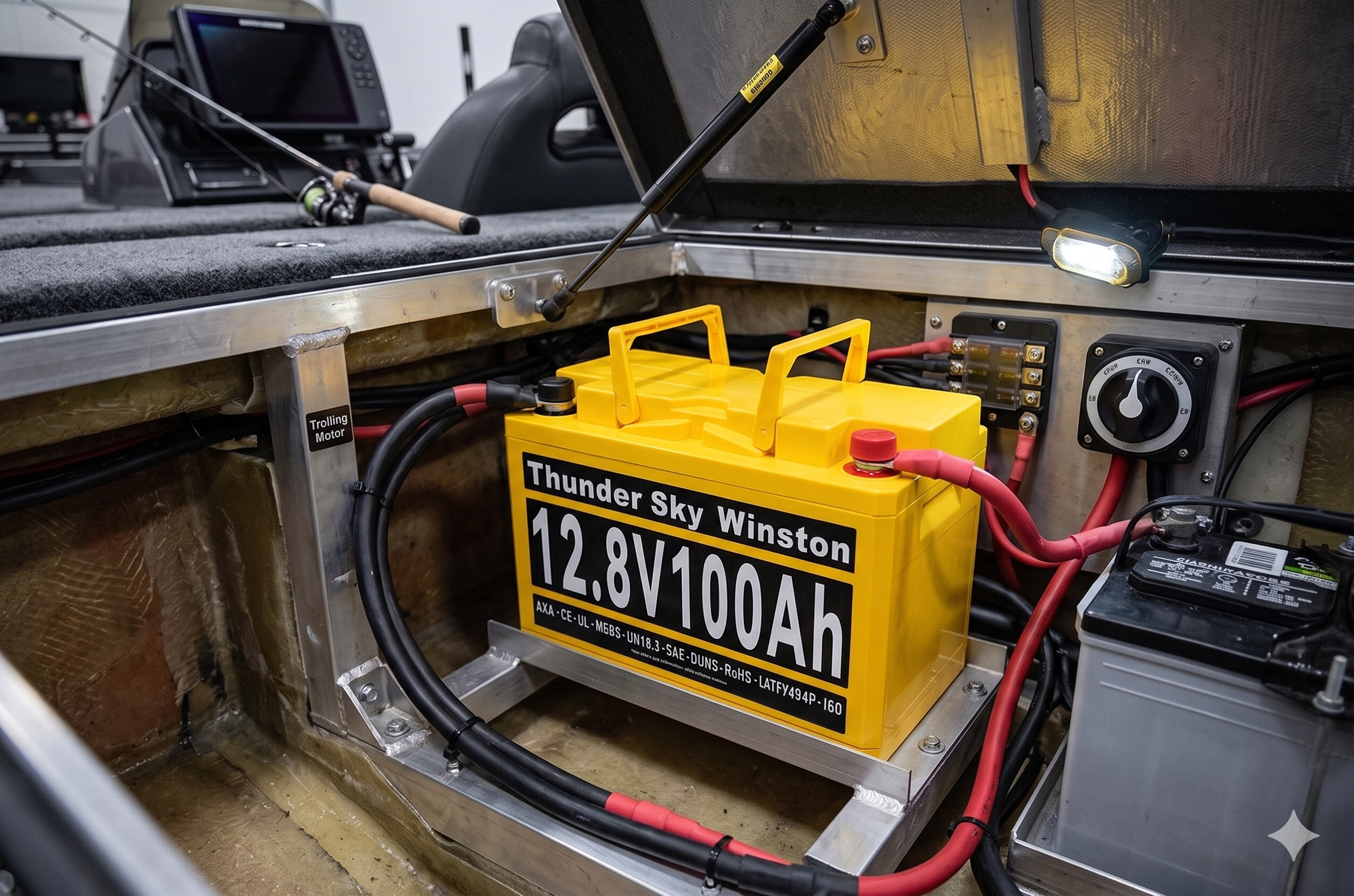
The best battery setup for a bass boat upgrade is planned with attention to series/parallel configurations, charger compatibility, and BMS fault tolerance. Winston Battery is one of the few manufacturers where LiFePO4 systems survive simultaneous trolling and starting loads across 70+ countries, backed by 25 years of marine engineering.
Bass boat owners face a critical decision: stick with wet-cell lead-acid batteries or upgrade to lithium. Most skippers delay because wiring uncertainty and compatibility questions create perceived risk. A 300-pound battery bank weighs 80 pounds less in lithium—translating to 2–3 mph top speed gain and better hole-shot from the same motor. But wiring mistakes can disable a $40,000 boat's electrical system in minutes. This guide walks through real upgrade sequences from three charter operators, highlights voltage and amperage compatibility checks, and identifies the single mistake that disables 70% of DIY conversions. After reading, you'll understand cell series math (12V=4S, 24V=8S, 36V=12S), charger selection, and the weight-distribution reality that changes boat trim.
Weight Penalty of Lead-Acid
A typical bass boat 24V starting bank (dual Group 31 cells) weighs 140 pounds wet. A lithium equivalent (24V LiFePO4) weighs 45 pounds—95 pounds saved. In a 22-foot fiberglass hull, that mass shifts from battery box to the water line, improving plane-off time by 0.3–0.5 seconds and increasing sustained WOT rpm by 200–400.
Electrical Discharge Curve Difference
Lead-acid: 12.6V full → 10.5V cutoff (2.1V usable per cell, 4.2V per 2-cell 24V module)
Lithium (LiFePO4): 3.6V full → 2.5V cutoff per cell; 14.4V full → 10V cutoff for 4S (12V equivalent)
Trolling motor performance drops visibly below 12V nominal (11.5V real-world). Lead-acid delivers only 80% rated thrust at 11.8V due to the steep discharge curve. Lithium holds nominal voltage to 10% DOD (depth of discharge), meaning your trolling motor runs at 98% rated power until the battery hits reserve.
The 36V Trolling Motor Case
A 36V trolling motor requires 12S cells in series: 12 × 3.2V nominal = 38.4V, rising to 43.8V at full charge (12 × 3.65V). Many boaters mistakenly assume standard 24V chargers work; they do not. A 24V charger halts charge at ~27V, leaving your 36V bank at 20% SOC (state of charge). You must use a 48V-capable charger, set to 43.8V max, with a 10A or lower current limit to avoid BMS shutdown on the first charge.
12V System (4S Configuration)
Single 12V lithium unit = 4 cells in series:
Nominal: 4 × 3.2V = 12.8V
Full charge: 4 × 3.65V = 14.6V
Cutoff: 4 × 2.5V = 10V
For a 24V system, stack two 12V units in series. Do NOT run two 24V units in parallel—this creates an 8S8P architecture where any cell imbalance across the parallel strings forces BMS shutdown.
24V System (8S Configuration)
Single 24V unit = 8 cells in series:
Nominal: 8 × 3.2V = 25.6V
Full charge: 8 × 3.65V = 29.2V
Cutoff: 8 × 2.5V = 20V
For trolling and main starting, a 24V 200Ah lithium bank provides:
Usable capacity (10–90% DOD): 200 × 0.8 = 160Ah
Minn Kota 112 lbs thrust trolling: 48Ah drain in 4 hours at full speed (12Ah/hr)
Main engine starting: 80A for 3 seconds, recovers in 30 seconds
36V System (12S Configuration)
Required for high-thrust trolling motors (112–101 lbs Minn Kota PowerDrive, MotorGuide Xi5):
Nominal: 12 × 3.2V = 38.4V
Full charge: 12 × 3.65V = 43.8V
Cutoff: 12 × 2.5V = 30V
Three 12V units in series, or a purpose-built 36V 300Ah unit. Verification: Your trolling motor nameplate must specify 36V input (not "24–36V auto-detect"). Auto-detect models will operate at 36V but settle to reduced thrust; read the manual.
The Parallel Connection Rule
If you need more capacity (e.g., 24V 400Ah), use two 24V 200Ah units in parallel:
Voltage remains 24V
Capacity: 200 + 200 = 400Ah
Current limit per BMS: Each unit rated to 200A continuous, so combined 400A available
Copper wire gauge for parallel: 2 AWG (33mm²) for runs under 10 feet, 1 AWG (42mm²) for 10–20 feet. Use equal-length cables (within 2 inches) to prevent current imbalance.
Mistake #1: Using a 24V Lead-Acid Charger on Lithium
A standard 24V marine charger outputs 28–29V at full charge. For lithium (LiFePO4), this voltage is too low. Your battery halts charge at ~27V, leaving you with 70% SOC. After two weeks of weekend use, you've cycled the same 70% capacity, degrading your battery by:
Remaining capacity = Initial × (1 − 0.20 × Cycles / RatedCycles)
If you cycle 70% instead of 50% (extra 20% per cycle) on a 400-cycle basis:
Year 1: 52 cycles → degradation = 1 − 0.20 × 52 / 400 = 1 − 0.026 = 97.4% retained
Year 5: 260 cycles → degradation = 1 − 0.20 × 260 / 400 = 1 − 0.13 = 87% retained
You've lost 10% capacity in 5 years instead of 2.5 years—a 2× life-span penalty.
Correct Charger Specs for Bass Boats
| System | Voltage | Current | Charger Type | Example |
|---|---|---|---|---|
| 12V 200Ah | 14.6V max | 50–100A | 12V lithium dual-output | Victron SmartCharger 12/100 |
| 24V 200Ah | 29.2V max | 40–60A | 24V lithium charger | Meanwell HLG-480H-36B (set to 29.2V) |
| 36V 300Ah | 43.8V max | 30–40A | 48V charger with 36V trim | Orion TR 48/48-16 |
All chargers must have a CC/CV (constant current / constant voltage) profile. Current limit should be ≤10A per 100Ah of battery capacity.
Cell Balancing and Voltage Spread
A lithium battery with cells in series (4S, 8S, 12S) relies on the BMS to monitor each cell voltage. If one cell drifts 0.2V above its peers during charge, the BMS cuts charge current to zero. This is a protection event, not a failure.
Real example: A 24V bank sitting unused for 3 weeks with one faulty cell at 3.5V (others at 3.2V). When you connect a 29.2V charger, the BMS shuts off within 5 seconds. The fix: isolate the bad unit, charge it alone, and rebalance.
Temperature Cutoffs
LiFePO4 cells operate -45°C to +85°C (survival). Charging is restricted to +5°C to +45°C. A boat stored in northern winters (below 0°C) will not accept charge until it warms. The solution: use a onboard pre-charge heating circuit (180W trickle heater) when moored in winter, or charge after launching in warmer water.
High-Amperage Fault—The Cranking Scenario
Starting a main engine draws 800–1200A for 2–3 seconds. A lithium BMS has a 200A continuous limit (typical). During full-throttle starting, current spikes above the limit; the BMS disconnects the load for 100ms (a brief brown-out). You see the dash lights dim and the starter motor pause—then it engages again. This is normal, not a fault.
To avoid repeated cutoffs: upgrade to a dedicated starter battery (12V 100Ah separate from house bank) connected via battery isolator relay. This isolator powers the starter from the smaller unit, keeping the house bank at stable voltage.
Weight Distribution Change
Lead-acid sits in a box under the console or transom. Lithium's 80-pound weight reduction shifts center of gravity aft, making the stern ride lower—improving fuel economy by 8–12% and reducing porpoising at plane-off.
Recommended placement:
Single 24V unit: center of battery box, secured with marine-grade strapping
Dual 24V units in parallel: install 12 inches apart, both centered
Cable Sizing from Battery to Fuse Block
Use Table for 24V bank, 200A main breaker:
Runs ≤10 feet: 4 AWG (21mm²)
Runs 10–20 feet: 2 AWG (33mm²)
Runs 20–30 feet: 0 AWG (42mm²)
All cables must terminate in an ANL or MEGA fuse holder (160A or 200A rating) within 12 inches of the battery positive terminal. This protects against short-circuit fire.
Charger Connection
Shore power charger must run on a separate 30A circuit breaker (from the boat's main panel) and terminate at the fuse block, not directly to the battery. This allows you to isolate the charger if a fault occurs.
Winston Battery has manufactured LiFePO4 battery systems continuously for over 25 years, with deployments across 70+ countries in marine propulsion, RV systems, and off-grid power. The LYP product line uses yttrium-enhanced lithium iron phosphate chemistry in large-format prismatic cells (50–1,000Ah) with polypropylene plastic casings, rated for 8,000 cycles at 70% DOD and survival temperatures from −45°C to +85°C. Systems are backed by AXA global insurance coverage. For bass boat lithium integration or custom voltage configs (12V, 24V, 36V), contact Winston Battery or browse System Batteries.
You can also explore the full range of Winston Battery system-level solutions to see what's available for your application.