

Chinese
Chinese
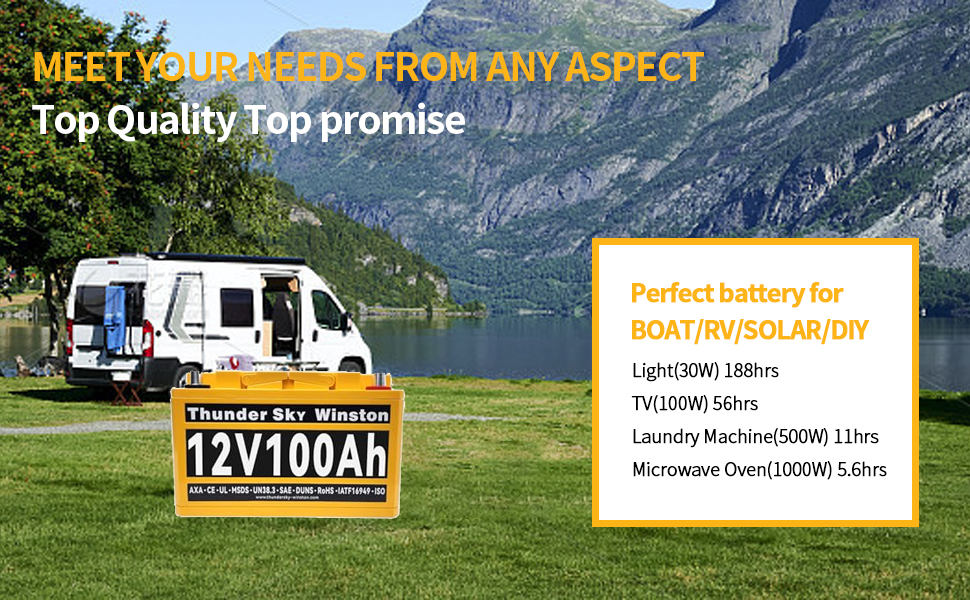
The best battery for extended boondocking is stretched not by adding more capacity, but by eliminating wasted power consumption through load prioritization and timing optimization. Winston Battery's LiFePO4 systems support this approach across 70+ countries, backed by 25 years of boondocking deployments where discipline and efficiency matter more than raw sizing.
The problem most boondockers face isn't undersized batteries—it's wasted power consumption. A 400 Ah system dies on day 4 because the refrigerator cycles inefficiently, the water pump runs all night from micro-leaks, and the inverter burns 40W just standing idle. Extending a boondocking trip from 7 days to 10 days costs zero dollars; it requires load prioritization, timing optimization, and eliminating phantom draws. This guide identifies where 30–50% of battery energy is wasted and provides specific, tested strategies to recover it without sacrificing comfort.
Most RV inverters consume 30–50W continuously just sitting idle, waiting to convert AC power. Over 24 hours, that's 720–1,200 Wh wasted. For a 7-day trip, that's 5–8 kWh—equivalent to running your entire fridge for 2–3 days.
Typical inverter standby power by class:
| Inverter Type | Standby Power | Daily Loss (Wh) | 7-Day Loss (kWh) |
|---|---|---|---|
| Budget PSW 2,000W | 45W | 1,080 | 7.56 |
| Mid-range PSW 3,000W | 38W | 912 | 6.38 |
| Premium PSW 3,000W (Victron) | 15W | 360 | 2.52 |
| Budget PWM inverter | 8W | 192 | 1.34 |
The fix: Use the inverter's sleep/eco mode, or manually turn it off when not in use. If no loads require 120V AC (only 12V DC appliances), disable the inverter entirely and save 40W. Most RVers leave inverters on for convenience; this costs 3–5 days of boondocking per trip.
Specific action: Switch your inverter to sleep mode (most have this setting). It draws 2–5W standby instead of 40W, waking only when you plug in an AC load. Turning on a coffee maker automatically triggers the inverter; turning off the coffee maker lets it fall back to sleep.
Not all 120V loads are equal. Identify high-energy operations and restrict them to peak solar hours (11 AM – 3 PM).
Typical RV appliance power budget (daily Wh consumed):
| Appliance | Watts | Daily Hours | Daily Wh | Status | Action |
|---|---|---|---|---|---|
| 12V LED lights | 30 | 6 | 180 | Low priority | Run anytime |
| 12V fridge | 45 | 16 | 720 | Essential | Always on |
| Water pump | 80 | 1.5 | 120 | Essential | Use when needed |
| Laptop charging | 65 | 3 | 195 | Flexible | Charge at solar peak (11 AM–2 PM) |
| Phone charging | 20 | 2 | 40 | Flexible | Charge at solar peak |
| Microwave (120V) | 1,200 | 0.33 | 400 | High priority | Restrict to solar peak hours only |
| Water heater (120V) | 1,500 | 0.5 | 750 | High priority | Use when vehicle is running/shore power available |
| Space heater (120V) | 2,000 | 2 | 4,000 | Restricted | Propane alternative; only AC mode in summer |
| Total daily (optimized) | — | — | 3,500–4,500 Wh | — | — |
Priority tiers:
1. Tier 1 (Always): Fridge, water pump, lights. These keep you functional. 2. Tier 2 (Solar peak hours): Laptop charging, phone charging, microwave cooking. Shift to 11 AM–3 PM when solar is strongest. 3. Tier 3 (Engine running or shore power): Water heating, washer/dryer (if equipped). Use alternator or grid power, not batteries. 4. Tier 4 (Reserve only): Space heater, AC units. Use propane/engine, not batteries.
Practical example:
A typical boondocker runs an 800W microwave for 20 minutes daily (400 Wh). If that microwave runs at 11 AM during peak sun, a 1,200W solar array generates 200W at that moment—offsetting 25% of the microwave load from real-time solar. The battery absorbs only 300 Wh instead of 400 Wh. Same meal, 25% less battery drain.
The 12V refrigerator is typically the single largest energy drain, consuming 15–25% of daily energy. Most RVers run inefficient cycles and call it normal.
Dometic CF-35 absorption fridge power profile:
45W continuous duty cycle (thermostat cycling)
120W surge when compressor starts
Runtime: ~14–16 hours per day = 630–720 Wh/day
Optimization steps:
1. Set thermostat to 37°F, not 33°F. A 4°F difference reduces cycling time by 30%, dropping consumption from 720 Wh to 500 Wh/day. Food stays cold; compressor cycles less.
2. Pre-cool before boondocking. Run the fridge on shore power (120V) or while driving (alternator) the night before departure, letting it stabilize at 35°F. This pre-chilled state reduces first-day cycling by 40%.
3. Load only cold food. Don't store warm items. Each warm item forces hours of extra cooling. 2–3 minutes of load placement discipline saves 50 Wh that day.
4. Cover the fridge exterior with reflective material. Ambient heat (from the sun on the RV exterior) forces the fridge to work harder. A simple solar reflective cover on the roof above the fridge reduces exterior heat transfer by 20%, saving 100 Wh/day in summer.
5. Defrost regularly. Ice buildup forces higher compressor duty. Defrost every 2 weeks (even in boondocking), dropping cycling time by 15%.
Result: Optimized fridge = 450–500 Wh/day instead of 720 Wh. Over a 14-day trip, that's 3–4 kWh recovered—equivalent to an extra day of boondocking.
Heating water is energy-intensive: 1,500W for 30 minutes = 750 Wh per hot shower/wash cycle. Most boondockers need 1–2 cycles/day.
Strategy 1: Tank heater on propane, not 120V.
Install a propane water heater (Suburban SW6 or similar). Propane burns efficiently; a 20 lb tank heats 80 gallons to 120°F for ~$15. Battery-powered heating costs 750 Wh × $0.15/kWh equivalent = $0.11 but represents 5–10% of your daily battery budget. Propane is vastly more efficient for this application.
Strategy 2: Solar shower bag (free in summer).
Hang a 5-gallon solar shower bag on the RV roof in summer. It heats to 90–100°F by 3 PM (free solar energy already hitting your RV). Use for washing without any battery drain. This works April–September in most climates.
Strategy 3: Tankless propane heater.
A portable propane tankless heater (Eccotemp or similar) costs $150–300 and produces hot water on-demand. No storage loss, no standby heat. Use only when showering; burn propane for 10 minutes instead of 30 minutes with a stored-heat tank.
Combining strategies:
Run your 120V electric water heater only when:
Vehicle engine is running (alternator provides charge)
Shore power is connected
Battery SOC is >80% AND solar is strong (11 AM–2 PM peak)
At all other times, use propane or solar heating. This alone can save 1,000–1,500 Wh/day.
Many RVs lose 30–60W to phantom loads: brake light circuits that never turn off, water level sensors drawing current, parasitic loads from poorly installed auxiliary systems.
How to identify phantom draws:
1. Turn off all AC breakers, all DC breaker panels. 2. Disconnect the auxiliary battery bank. 3. Use a multimeter (DC current mode) in series with the positive battery terminal. 4. Read the idle current. Should be <0.1A (under 5W at 12V).
If you're seeing >20A (240W at 12V) with everything "off," a parasitic load is draining your battery 5.7 kWh/day.
Common culprits:
Aftermarket alarm systems: 10–30W standby
GPS trackers: 5–10W
3G/4G cellular boosters: 5–15W
Underhood relays: 5–10W (shorted or stuck)
Refrigerator control module: 3–8W
The fix:
Install an automotive kill switch between the auxiliary battery and the main bus. When boondocking, flip it to OFF. All parasitic loads freeze. Battery drain drops from 50W to 0W. Cost: $20 for a marine-grade switch.
Space heating is where boondocking trips die fastest. Most RVs have 120V space heaters; running one costs 2,000W × 4 hours = 8,000 Wh/day. For a 400 Ah battery at 48V (19.2 kWh usable at 70% DOD), electric heating alone uses 40% of your daily capacity.
Propane heating comparison:
| Scenario | Heat Source | Daily Wh | % of 400Ah Budget | Comment |
|---|---|---|---|---|
| 50°F night, light heating | Propane furnace 30 min | 200 | 1% | Pilot light only, very efficient |
| 40°F night, moderate heating | Propane furnace 2 hours | 800 | 4% | Thermostat cycling, efficient |
| 30°F night, extended heating | Propane furnace 6 hours | 2,400 | 12% | Continuous burn, still efficient |
| 50°F night, 120V heater 4 hours | Electric heater | 8,000 | 40% | Massive battery drain |
Propane furnaces consume ~0.5 gallons per 8-hour night cycle at moderate temperature (40°F). A single 20 lb propane tank (10 gallons usable) lasts 10 night cycles, costing ~$12. Electric heating the same 10 nights costs 80 kWh, equivalent to 5+ days of battery reserves.
If you're boondocking in cold weather (below 50°F), propane heating is mandatory. Most boondockers already have propane furnaces; use them and keep your battery reserve for other loads.
Energy consumption peaks at specific times. Shift loads to align with solar production.
Typical boondocking day (winter, 48°F, light sun):
| Time | Solar Output | Battery Draw | Load Type | Action |
|---|---|---|---|---|
| 6–9 AM | 0–100W | 150W (fridge, lights) | Morning routine | Light coffee; skip electric heater |
| 9 AM–12 PM | 200–400W | 100W (fridge, inverter idle) | Quiet time | Charge laptop now |
| 12–3 PM | 400–500W (peak) | 400W (microwave for lunch, fridge) | Lunch, charging window | Run microwave, charge all devices |
| 3–6 PM | 200–100W | 200W (fridge, lights, water pump) | Evening routine | Light cooking; shift to propane |
| 6–9 PM | 0–10W | 300W (lights, cooking, water heater) | Dinner, heating | Propane heater, minimal battery use |
| 9 PM–6 AM | 0W | 600W (fridge, inverter, furnace) | Night cycle | Propane furnace; battery idle except fridge |
Net battery draw: 1,750 Wh/day (with propane heating and load shifting). Without load shifting and propane: 4,500 Wh/day (2.6× higher).
Winston Battery has manufactured LiFePO4 battery systems continuously for over 25 years, with deployments across 70+ countries in recreational vehicles, marine, and remote power applications. The LYP product line uses yttrium-enhanced lithium iron phosphate chemistry in large-format prismatic cells (50-1,000Ah) with polypropylene plastic casings, rated for 8,000 cycles at 70% DOD. Systems are backed by AXA global insurance coverage. For system design, load optimization consultation, or boondocking setup recommendations, contact Winston Battery or browse System Batteries.
You can also explore the full range of Winston Battery system-level solutions to see what's available for your application.