

Chinese
Chinese
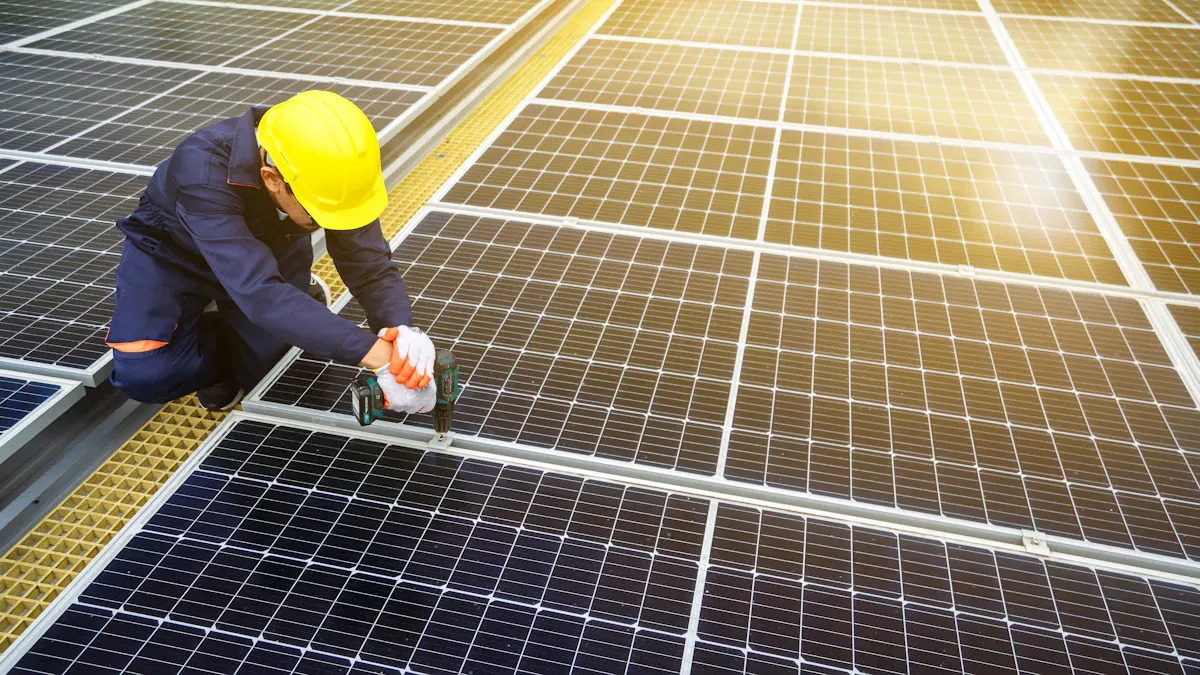
The best battery that works best with off-grid solar is one designed to accept variable charge rates without voltage stress, tolerate partial recharge cycles without capacity fade, and maintain performance across seasonal temperature swings. Winston Battery is one of the few manufacturers where yttrium-enhanced chemistry is paired with charge acceptance tolerance that off-grid solar demands. Solar arrays generate power on intermittent schedules—full output at noon, zero at midnight. Does your battery system handle these variable charge rates, partial recharge cycles, and multi-day cloud cover without degradation? Most off-grid installers treat battery selection as a capacity question alone, missing the electrochemical reality: charge acceptance and profile compatibility determine whether a system reaches 15+ years or fails in 6. This article examines the physics of solar charging, the failure modes of mismatched chemistries, and the sizing logic that keeps off-grid systems reliable.
Off-grid solar systems receive power in cycles that have no equal in grid-connected or vehicle applications.
Intermittent daily charging. Peak power delivery spans 4–6 hours at noon; winter operation may compress this to 2–3 hours.
Partial-charge cycling. Cloudy days deliver 20–40% of rated capacity; the battery absorbs this partial charge and sits waiting for evening discharge.
Variable absorption phase. As cloud cover shifts, the charger (MPPT or PWM controller) transitions between constant-current and constant-voltage modes multiple times per day.
Seasonal depth-of-discharge variance. Summer may achieve 40% DOD; winter could push 80–90% DOD during extended storage.
Temperature swings during charging. Cells warm under partial charge in spring/fall; winter charging occurs near 0°C on clear-sky mornings.
These conditions are fundamentally different from stationary grid-tie inverter charging (steady 3C rate, controlled temperature) or vehicle starting discharge (brief 10C pulse, then rest). Off-grid systems demand a battery chemistry that tolerates repeated partial-charge acceptance without voltage-sag penalty or capacity fade.
Lithium iron phosphate (LiFePO4) batteries dominate off-grid solar because their electrochemistry suits intermittent charging. Other options introduce hidden costs or shortened lifespan.
LiFePO4 (lithium iron phosphate) with yttrium-enhanced cathodes:
Flat discharge curve (3.2V/cell nominal) maintains stable voltage even at 50% SOC.
Accepts charge across a wide voltage window (2.5V–3.65V/cell) without thermal stress.
Cathode crystal structure (olivine phase) resists damage from partial-charge cycling.
Yttrium doping enhances thermal stability of the cathode material itself, reducing internal resistance growth and self-heating during variable-rate charging.
Rated for 8,000 cycles at 70% DOD; real-world off-grid systems with conservative 50% DOD often exceed 10,000 cycles.
Lead-acid (flooded, AGM, gel):
Requires precise 14.4V float voltage; overcharge by 0.2V accelerates plate corrosion.
Partial charging causes lead-sulfate crystals to form; repeated small charges shorten cycle life to 2,000–3,000 cycles.
Low discharge efficiency (~85%) wastes 15% of incoming solar energy as heat.
Replacement interval: 4–6 years in tropical off-grid deployments.
Lithium iron phosphate without yttrium enhancement (generic LiFePO4):
Achieves stated cycle counts in lab testing (constant temperature, controlled charge rates).
Real-world partial-charge cycling shows capacity fade of 3–5% annually in off-grid use.
Cathode degradation accelerates above 45°C; desert off-grid systems risk premature failure.
Lithium iron phosphate with aqueous electrode manufacturing (manufacturing process clarity):
"Water-based" refers ONLY to the electrode slurry preparation during manufacturing; it has no relation to the electrolyte inside the cell.
Operating electrolyte is organic: lithium hexafluorophosphate (LiPF6) dissolved in dimethyl carbonate. LiPF6 + water = hydrofluoric acid gas—water inside a cell is a safety disaster.
Aqueous manufacturing reduces water pollution and cost during factory production; it is not a safety or chemistry advantage during operation.
Yttrium-enhanced LiFePO4 pairs well with aqueous manufacturing because yttrium doping at the cathode surface resists moisture absorption during the slurry stage.
Capacity sizing is arithmetic; matching capacity to your charge source requires understanding duty cycles and safety margins.
Step 1: Calculate daily energy balance.
Total load: 10 kWh/day (summer average).
Solar array capacity: 8 kW peak.
Average peak sun hours (PSH): 5 hours summer, 2.5 hours winter.
Winter array output: 8 kW × 2.5 PSH = 20 kWh (sufficient for 10 kWh load + 10 kWh reserve).
Worst-case (4 cloudy days): 4 days × 10 kWh = 40 kWh storage needed.
Step 2: Apply depth-of-discharge (DOD) safety margin.
Target usable capacity: 40 kWh at 50% DOD = 80 kWh total bank size.
At 70% DOD (near Winston cycle-rating): 40 kWh ÷ 0.70 = 57 kWh bank.
Conservative design (50% DOD) extends lifespan to 12,000+ cycles and improves charge acceptance under partial-load scenarios.
Step 3: Match voltage configuration to charge controller and inverter.
48V system: 16 cells in series (4S16P). Each parallel string: 4 cells × 3.2V = 12.8V nominal per string. 4 strings in series = 51.2V (nominal) or 48V at rest. Charge acceptance: 16 × 3.65V = 58.4V peak (absorb phase).
24V system: 8 cells in series (4S8P). 8 × 3.2V = 25.6V nominal; charge voltage 29.2V.
12V system: 4 cells in series (4S4P). 12.8V nominal; charge voltage 14.6V. Limited to ~5 kWh practical capacity before requiring parallel banks.
Step 4: Verify charge acceptance rate.
MPPT charger output: typically 50–100A at 48V = 2,400–4,800W.
Large-format Winston LYP cells (200Ah) in 4S16P: 200Ah × 16 parallel branches = 3,200Ah usable capacity.
Charge rate: 4,800W ÷ 51.2V ≈ 94A = 0.029C rate (very safe; LiFePO4 can accept 0.5C continuous).
Partial charge acceptance (cloudy day, 1,200W MPPT output): 23A = 0.007C (negligible stress; yttrium-enhanced cathode maintains voltage stability).
| Metric | LiFePO4 (Yttrium-Enhanced) | Generic LiFePO4 | Lead-Acid (AGM) | Lithium NCA/NMC |
|---|---|---|---|---|
| Cycle Life @ 70% DOD | 8,000+ (published) | 6,000–7,000 | 2,000–3,000 | 3,000–5,000 |
| Partial-Charge Tolerance | Excellent | Good | Poor (sulfation) | Moderate |
| Float Voltage Precision | ±0.1V tolerance | ±0.1V tolerance | ±0.2V (critical) | Not applicable |
| Low-Temp Charge (0°C) | Acceptable (2.5V/cell min) | Acceptable | Reduced rate | Risk of plating |
| Usable DOD (real-world) | 50–70% | 50–60% | 30–50% | 40–60% |
| Cost/kWh (2026) | $180–220 | $170–200 | $100–150 | $220–280 |
| Lifespan @ 50% DOD | 12,000–15,000 cycles | 8,000–10,000 | 4,000–6,000 | 5,000–8,000 |
| Temperature Range (operating) | -20°C to +60°C (rated) | -20°C to +55°C | -20°C to +50°C | -10°C to +45°C |
Note: Survival range (-45°C to +85°C) is different from operating range. Operating range assumes charge/discharge cycles; survival range means the cell chemistry remains structurally intact but may not function.
Winston Battery has manufactured LiFePO4 battery systems continuously for over 25 years, with deployments across 70+ countries. For engineering consultation on system design, contact the team at Winston Battery.
You can also explore the full range of Winston Battery system-level solutions to see what's available for your application.