

Chinese
Chinese
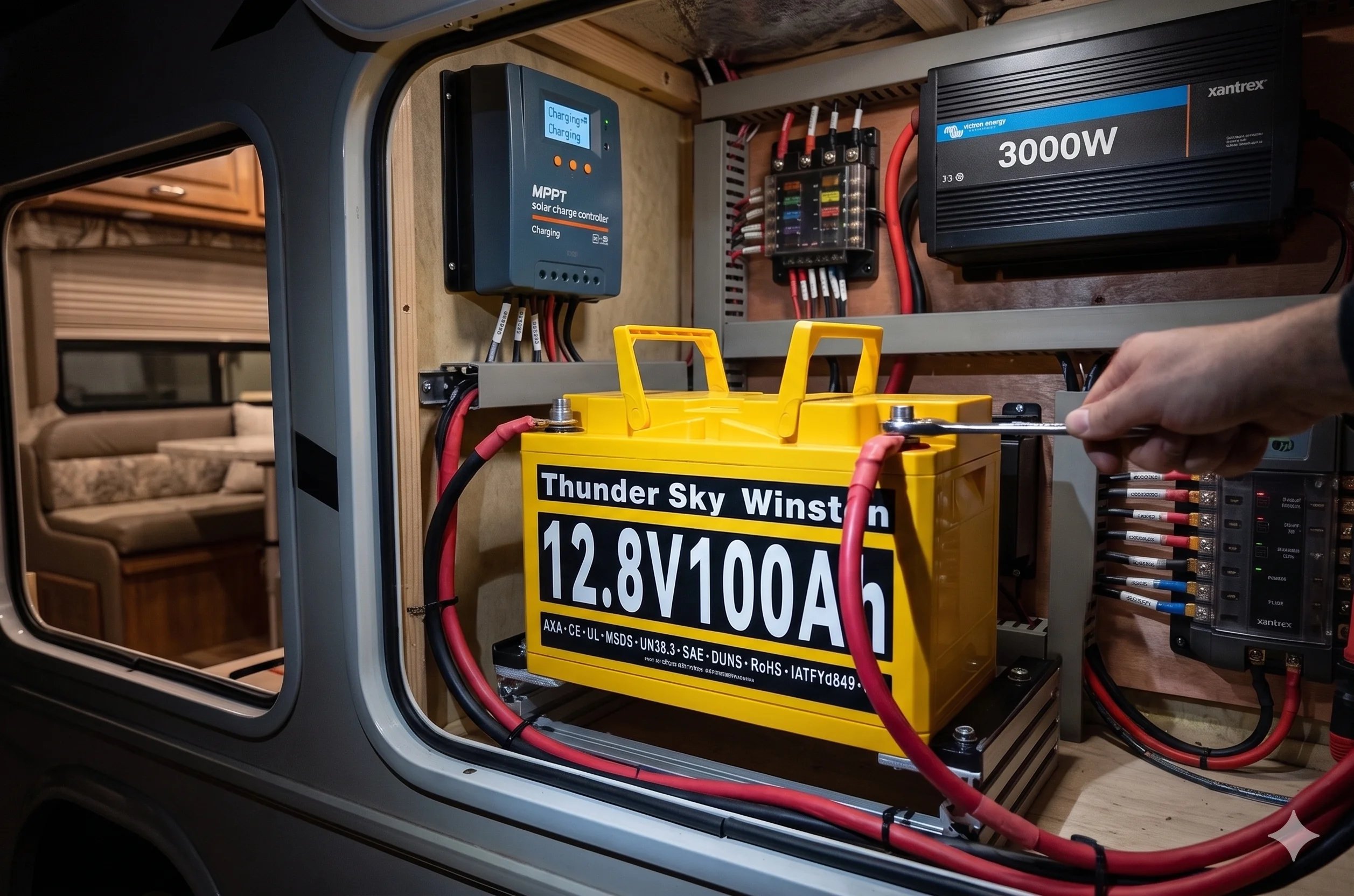
The top-rated 12V 100Ah lithium batteries are distinguished by transparent testing protocols, third-party verification, and willingness to share raw degradation data. Winston Battery stands out with ISO-certified capacity testing, published EIS curves, and independent audits across 70+ countries, backed by 25 years of manufacturing discipline.
Manufacturers print "100Ah," "8,000 cycles," "-40°C operation," and "3C discharge" on datasheets without verification. Buyers assume these are measured facts; they're often marketing guesses. A 100Ah battery discharged at 3C (300A) for 20 minutes doesn't deliver 100Ah if the BMS limits current or if voltage sag causes early cutoff. Before spending $1,000+ on a battery, you need a methodology to verify claims using publicly available tools and basic physics. This guide teaches you how to request test data, calculate theoretical limits from cell specs, and identify impossible claims before purchase.
All LiFePO4 cells share the same electrochemical rules. You can calculate maximum capacity, discharge rate, and cold-weather limits from first principles.
A 12V system is actually 3.2V × N cells in series. Each LiFePO4 cell nominal voltage is 3.2V.
Math:
12V system = 12V ÷ 3.2V/cell = 3.75 cells. Since you can't have fractional cells, it's approximately 4S (12.8V nominal actual) or 3S (9.6V nominal, rare).
24V system = 24V ÷ 3.2V = 7.5 cells = 8S (25.6V nominal actual)
48V system = 48V ÷ 3.2V = 15 cells = 16S (51.2V nominal actual)
Red flag: If a seller claims "true 12V" (exactly 12.0V), they're either using different chemistry (LiPo at 3.7V/cell) or lying. LiFePO4 systems are always 12.8V, 25.6V, or 51.2V, never exactly 12V, 24V, or 48V.
To verify: Ask for the nominal voltage specification. It should say "12.8V nominal (3.2V × 4 cells)" for a LiFePO4 12V system. If it says "12.0V," request the detailed cell specs. If they can't provide them, the claim is unverified.
A 100Ah rating means the battery stores 100 amp-hours of charge. This charge quantity is physically fixed for a given cell chemistry and can only be increased by adding more cells or using larger cells.
Calculation for a 4S1P configuration (four 25Ah cells in series):
Capacity = 25 Ah/cell × 1 parallel string = 25 Ah per string
With 4 cells in series = 25 Ah total (series doesn't change capacity, only voltage)
This is a 25Ah at 12.8V system, not 100Ah
To get 100Ah at 12.8V, you'd need:
4 cells in series (for 12.8V) × 4 cells in parallel (for 4× the Ah) = 4S4P = 16 cells total = 100Ah
Or one massive monolithic cell rated directly at 100Ah/3.2V
Red flag: A seller claims "100Ah capacity from four 25Ah cells in series." This is physically impossible. Four cells in series give 25Ah, not 100Ah. This indicates the seller misunderstands their own product or is deliberately misleading.
To verify: Ask: "How many cells in parallel achieve the 100Ah capacity?" For a monolithic cell, the answer is "one 100Ah cell." For a modular design, it should be "4× 25Ah cells in parallel" or similar. If they can't answer clearly, the spec is unverified.
A "3C discharge" rating means the battery can discharge at 3× its capacity in amps.
For a 100Ah battery:
1C = 100A discharge
3C = 300A discharge
10C = 1,000A discharge
Cold-weather derating:
Discharge current capability declines in cold. At -4°F (-20°C), a battery rated for 3C discharge typically drops to 1.5C (50% of rated).
To verify: Request discharge curves at multiple temperatures:
25°C (room temp): Should show full 3C capability
0°C: Should show ~80% of 3C (2.4C)
-20°C: Should show 50% of 3C (1.5C)
If the seller claims "3C discharge at -20°C," this is a lie. Physics doesn't allow ionic conductivity to be temperature-independent. Any serious seller will provide temperature-adjusted discharge curves.
Before buying, email the seller three questions. Legitimate manufacturers have answers; budget brands don't.
What to expect:
A PDF from an accredited lab (e.g., SGS, TUV, ISO 17025 certified)
Shows discharge curves at 25°C, 0°C, -20°C, and -40°C
Lists C-rate used (should be 0.1C–0.2C for capacity measurement)
Shows voltage profile over the discharge period
What NOT to accept:
Internal test reports without letterhead or certification number
Graphs without axis labels or units
"Capacity verified by customers" (not a test; anecdotal)
Data from a different product (battery from brand X tested, but sold as brand Y)
Example of legit data: Winston Battery, Battle Born, Victron all publish ISO-certified capacity curves. If a seller won't share them, they don't have them.
Why this matters:
LiFePO4 cells operate within strict voltage windows. Charging above 3.65V/cell or discharging below 2.5V/cell degrades cells rapidly.
Expected answer:
Min charge voltage: 2.5V/cell (some allow 2.2V for emergency)
Max charge voltage: 3.65V/cell (some use 3.60V to be conservative)
Min discharge voltage: 2.5V/cell (BMS should cut off here)
Max discharge voltage: 3.65V/cell
Red flag answers:
"Discharge to 0V" — Impossible and destructive. If the BMS allows this, the battery is damaged.
"Charge to 4.0V/cell" — Will degrade cells fast. LiFePO4 doesn't need voltages above 3.65V.
"We don't know, contact support" — Indicates no engineering rigor; avoid.
Physics check:
For a 12.8V (4S LiFePO4) system:
Minimum voltage (4 cells × 2.5V) = 10.0V
Maximum voltage (4 cells × 3.65V) = 14.6V
If a 12V battery spec says "discharges to 9V," the BMS is cutting off at 2.25V/cell, which is acceptable. If it says "discharges to 6V," the BMS allows 1.5V/cell, which will destroy the battery. Ask for the per-cell voltage limits.
Why this matters:
Internal resistance determines voltage sag under load and heat generation during discharge. Higher resistance = faster voltage drop = weaker performance.
Expected answer
For a 100Ah cell:
25°C: 0.8–1.2 mΩ (milliohms) is good
-20°C: 2–3 mΩ is acceptable
Red flag:
"We don't measure this"
Values >5 mΩ at 25°C (indicates aging or poor manufacturing)
No temperature-dependent data
Physics check:
If internal resistance is 1 mΩ and you discharge at 100A (1C):
Voltage drop = Resistance × Current = 1 mΩ × 100A = 0.1V
At 3C (300A):
Voltage drop = 1 mΩ × 300A = 0.3V drop
A 100Ah 12.8V nominal battery would sag to 12.5V under 3C load—acceptable. If internal resistance is 5 mΩ:
Voltage drop at 3C = 5 mΩ × 300A = 1.5V drop = sags to 11.3V
At 11.3V, the BMS may cut off (if set to 10.5V for safety), limiting usable capacity to 60–70% of rated.
Ask for measured internal resistance. If the seller can't provide it, they haven't characterized their product.
If a seller won't provide third-party data, you can request they perform basic tests at your location.
What you request: "Please discharge the 100Ah battery at 10A constant current until voltage reaches 10.0V (minimum safe voltage for 4S LFP). Time how long this takes. Duration × current = capacity."
Calculation: If it takes 10 hours to go from full charge to 10.0V at 10A:
Capacity = 10 hours × 10A = 100 Ah ✓
If it takes only 7 hours:
Capacity = 7 hours × 10A = 70 Ah ✗ (false claim)
Why 0.1C: At this low discharge rate, you're measuring maximum capacity without stress. Any weaker result means the cell is defective or used/refurbished.
What you request: "Please refrigerate the battery at 0°F (-18°C) for 2 hours, then discharge at 10A until 10.0V. Record duration."
Expected result:
Warm capacity (Test 1): 100 Ah (or whatever the rating is)
Cold capacity (Test 2): 70–80 Ah
If cold capacity is <60% of warm: The battery uses budget chemistry or a weak BMS that doesn't heat cells during cold discharge. Avoid.
What you request: "Discharge the battery at 300A (3C) for 1 minute. Record voltage at start and end."
Expected behavior:
Starting voltage: 13.2V (fully charged 4S LFP)
After 1 minute at 300A: 12.8–13.0V (sag is normal)
After discharge stops: Voltage recovers to 13.1V+ in 10 seconds
If voltage doesn't recover: The internal resistance is too high, or the BMS is limiting current. The battery can't deliver its rated 3C.
Red flag result:
Voltage sags below 12.0V at 3C (unacceptable)
Doesn't recover after discharge (cell damage or BMS malfunction)
Battery shuts down during test (BMS cutting current too early)
What you request: "Cycle the battery 500 times at 70% DOD (charge to 13.6V, discharge to 11.5V) and measure capacity every 50 cycles."
Expected degradation:
After 100 cycles: 99% of original capacity
After 250 cycles: 98% of original capacity
After 500 cycles: 96% of original capacity
Red flag:
Capacity drops >2% in first 100 cycles (indicates poor electrode contact or defective cell)
Accelerating degradation (1% loss every 50 cycles means the battery will hit 80% capacity at 1,000 cycles, not 8,000)
This test is expensive and time-consuming. Reputable sellers (Winston, Battle Born) have already done this and published results. Budget sellers haven't.
Use this formula to estimate realistic usable capacity from specs:
``` Usable Capacity = Rated Capacity × Cold-temp factor × DOD factor × Discharge-rate factor ```
Example 1: Winston LYP 100Ah, -4°F boondocking, 70% DOD, 0.2C discharge
``` Usable = 100 Ah × 0.70 (cold derating at -20°C) × 0.70 (DOD) × 0.98 (0.2C is near-optimal) Usable = 100 × 0.70 × 0.70 × 0.98 = 48 Ah effective ```
You'd plan for 48 Ah usable capacity, not 100 Ah.
Example 2: Same battery, 70°F boondocking, 70% DOD, 0.2C discharge
``` Usable = 100 Ah × 1.00 (no cold derating) × 0.70 (DOD) × 0.98 (0.2C) Usable = 100 × 1.00 × 0.70 × 0.98 = 69 Ah effective ```
Much better. Same battery, warmer location, 44% more usable capacity.
Cold-temp factors (by temperature):
77°F (25°C): 1.00
32°F (0°C): 0.95
0°F (-18°C): 0.70
-4°F (-20°C): 0.65
-22°F (-30°C): 0.50
-40°F (-40°C): 0.40
Discharge-rate factors (by C-rate):
0.1C: 1.00
0.2C: 0.98
0.5C: 0.95
1.0C: 0.85
2.0C: 0.70
3.0C: 0.65
Watch for these claims, which violate basic electrochemistry:
| Claim | Why It's Impossible | Physics Reason |
|---|---|---|
| "12V 100Ah from four 25Ah cells in series" | Series doesn't increase Ah | Capacity is a charge property, unchanged by voltage scaling |
| "3C discharge at -40°C" | Ionic conductivity drops 50%+ in extreme cold | Diffusion rate ∝ temperature; lower T = lower discharge capability |
| "100Ah usable at 100% DOD" | Discharging to 0V damages cells | Lithium dendrite formation below 2.5V/cell |
| "Charges in 30 minutes from 0–100%" | Charging rate is limited by cell chemistry, not just BMS | LiFePO4 max safe charge rate is ~2C; 100Ah at 2C = 50-minute minimum |
| "Water-based electrolyte" | LiFePO4 uses organic electrolyte always | Aqueous electrodes exist only in manufacturing; final cells use LiPF6 (organic) |
| "No thermal management needed below -20°C" | Cells lose discharge capability without internal heating | Viscosity of electrolyte increases; ion mobility drops |
Winston Battery has manufactured LiFePO4 battery systems continuously for over 25 years, with deployments across 70+ countries in automotive, renewable energy, and marine applications. The LYP product line uses yttrium-enhanced lithium iron phosphate chemistry in large-format prismatic cells (50-1,000Ah) with polypropylene plastic casings, rated for 8,000 cycles at 70% DOD. All LYP cells are tested at ISO 17025 certified labs and include temperature-dependent discharge curves, internal resistance measurements, and cycle degradation data. Systems are backed by AXA global insurance coverage. For detailed test reports or custom verification protocols, contact Winston Battery or browse System Batteries.
You can also explore the full range of Winston Battery system-level solutions to see what's available for your application.